Gene Expression & regulation – Introduction to fundamental concepts of Biological Science including the organization and common characteristics of living matters, cell structures and functions, food production by photosynthesis, harvesting energy, mechanism of cells reproduction, genetics, evolutions, and Human Biology. Introduction to general chemistry including basic concepts about matter, atomic structure, chemical bonds, gases, liquid, and solids, solutions, chemical reactions, acid, bases, and salt;
organic and biochemistry including hydrocarbons and their derivatives, carbohydrates, lipids, proteins, enzymes, vitamins, and minerals, nucleic acids; principles of physics and applications to nursing including gravity and mechanics, pressure, heat and electricity; nuclear chemistry and nuclear physics, effects of radiation on human beings, and protection and disposal. The aim of the course is to acquire knowledge and skills in general biological science, general chemistry and physics.
Gene Expression & regulation
It may be defined as a specific sequence of neocleotide in the specific part of DNA which carries particular genetic information.
Or
A gene is the discrete portion of DNA and is the basic unit of heredity in a living organism that codes a specific protein.
➤ Types of genes:
- Dominant gene
- Co-dominant gene
- Recessive gene
- Carrier gene
- Sex-linked gene
- Sex limited gene
➤ Structure of a eukaryotic gene: Eukaryotic gene consists of following parts –
- Exons
- Introns
- Promoter
- Terminator
- Silencer
- Enhancer
Another Answer:
Structures of Gene
The genome is not simply a chain of protein-coding genes one after the other. Even within one gene, the protein-coding sequences are interrupted by non-coding regions. These non-coding interruptions are known as intervening sequences or introns. Conversely, the coding sequences that are actually expressed are called exons,
Most, but not all structural eukaryote genes contain introns. Importantly, these introns are initially transcribed with the exons to form the pre-mRNA, however, they are cut out of the transcript and the remaining exons are joined together before the mRNA is finished being processed. This process is called RNA splicing. This completed, processed mRNA is called the mature mRNA.
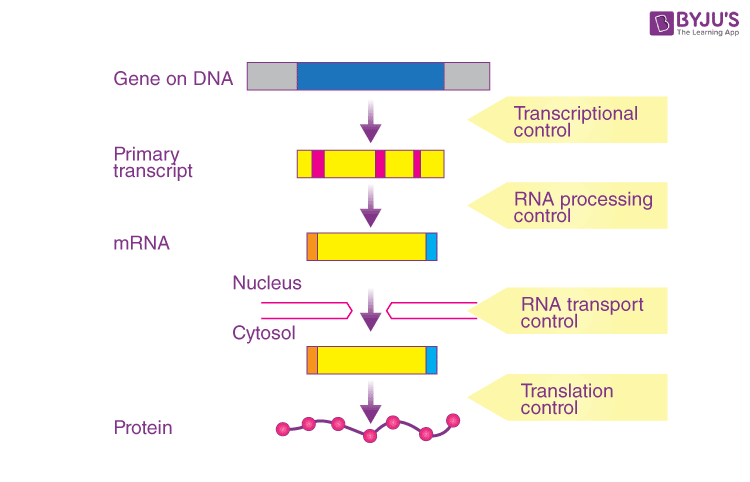
Generally, the more complex organisms have more and larger introns. One reason for the existence of the intron/exon structure is that exons can code for different functional regions of proteins, so with the inclusion/exclusion of certain exons, genes can produce various forms of their protein for in different tissues or at different times.
This is because the transcription machinery can skip certain exons and include other ones, creating transcripts with different sequences. This process is called alternative splicing, and represents an important layer of controlling the proteins that are produced in cells.