Concept about Buffer – Introduction to fundamental concepts of Biological Science including the organization and common characteristics of living matters, cell structures and functions, food production by photosynthesis, harvesting energy, mechanism of cells reproduction, genetics, evolutions, and Human Biology. Introduction to general chemistry including basic concepts about matter, atomic structure, chemical bonds, gases, liquid, and solids, solutions, chemical reactions, acid, bases, and salt;
organic and biochemistry including hydrocarbons and their derivatives, carbohydrates, lipids, proteins, enzymes, vitamins, and minerals, nucleic acids; principles of physics and applications to nursing including gravity and mechanics, pressure, heat and electricity; nuclear chemistry and nuclear physics, effects of radiation on human beings, and protection and disposal. The aim of the course is to acquire knowledge and skills in general biological science, general chemistry and physics.
Concept about Buffer
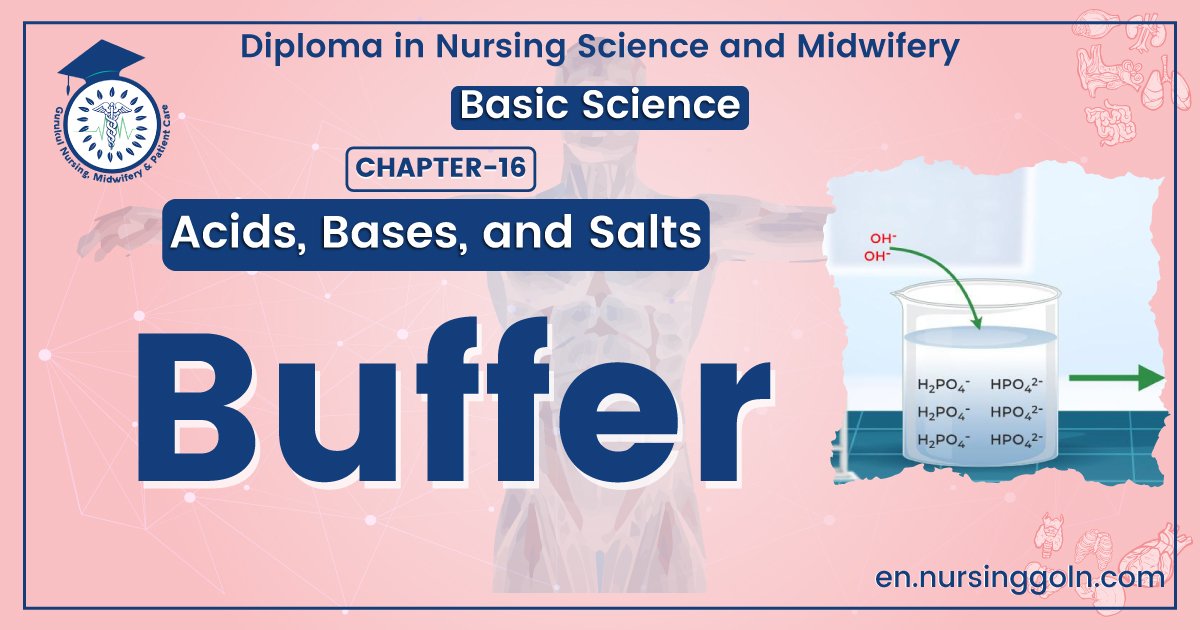
Buffer is a mixture of weak acid and its salt with strong base that tends to maintain a constant pH of a solution when acid or alkali is added to it within certain limit.
Example:
➤ Bicarbonate buffer [ NaHCO3/HCO3 ] (present in highest concentration in the body fluid)
➤ Haemoglobin buffer = K-Hb/HHb
Note:
- Most important extracellular buffer or major buffer of blood: Bicarbonate buffer.
- Most important intracellular buffer: Haemoglobin buffer.
- Important kidney buffer: Phosphate buffer.
- Important buffer in respiratory system: Bicarbonate buffer.

Classification of Buffer:
Buffer can be classified into two main classes –
1. Extracellular buffer or physiological buffer.
2. Intracellular buffer.
Extracellular buffer again can be divided into –
i. Bicarbonate buffer: NaHCO3/HCO3
ii. Phosphate buffer: NaHCO3/HCO3
iii. Protein buffer: Na-Protein/H-Protein
Intracellular buffer again can be divided into –
i. Bicarbonate buffer: NaHCO3/HCO3
ii. Phosphate buffer: Na2HPO4/NaH2PO4
iii. Hemoglobin buffer: KHb/HHb
iv. Oxyhemoglobin buffer: K.HbO2/H.HbO2
Importance of Buffer:
- Maintains the pH of body fluid, which is essential for the optimal activity of enzymes.
- Buffers are used to determine the pH with indicator.
- Buffers regulate the neutrality of the body within a relatively narrow limit of pH, compatible for the life of most cells
Buffering capacity:
Buffering capacity can be defined as the amount of acid or alkalis needed to bring out a unit change of PH.
Buffering capacity depend upon:
- PK value of the acid present in the buffer solution.
- Molar concentration of the buffer component.
[NOTE]
Carefully note that, Buffer capacity is inversely proportional to buffer power. So,
- Buffer capacity of phosphate buffer is high.
- Buffer capacity of bicarbonate buffer is low.
- Buffer power of phosphate buffer is low.
- Buffer power of bicarbonate buffer is high.