Definition of Tetanus – Health of the children has been considered as the vital importance to all societies because children are the basic resource for the future of humankind. Nursing care of children is concerned for both the health of the children and for the illnesses that affect their growth and development. The increasing complexity of medical and nursing science has created a need for special area of child care, i.e. pediatric nursing.
Pediatric nursing is the specialized area of nursing practice concerning the care of children during wellness and illness. It includes preventive, promotive, curative and rehabilitative care of children. It emphasizes on all round development of body, mind and spirit of the growing individual. Thus, pediatric nursing involves in giving assistance, care and support to the growing and developing children to achieve their individual potential for functioning with fullest capacity.
Definition of Tetanus
Tetanus
Tetanus is an acute infectious bacterial disease caused by Clostridium tetani and characterized by muscular stiffness and painful paroxysmal spasms of the voluntary muscles caused by the powerful neurotoxin of the causative organism.
Or
Tetanus is a wound infection caused by Cl. tetani. Occurring usually in the deep, contused, soil contaminated injuries with pyogenic organism it containing foreign bodies.
(Ref by: Paediatric Nursing, Parul Datta/3/236)
A. Incubation period: 6-10 days
B. Agent factors:
- Agent: Clostridium tetani is a Gram positive, spore bearing and anaerobic bacteria.
- Reservoir of infection: Soil and dust, intestine of herbivorous animals (eg. cattle, goats, ship etc)
C. Patient factors:
- Occupation: Agricultural workers mostly affected
- Immunity: No age is immune unless protected by immunization
Classification of Tetanus;
Based on related causes
- Traumatic
- Otogenic
- Neonatal
- Puerperal and
- Idiopathic
Clinical types
- Localized
- Generalized and
- Cephalic
Clinical Features of Tetanus:
Localized Tetanus:
- Pain
- Constant rigidity
- Muscle spasm in the region of injury.
- It may be associated with otitis media
Generalized tetanus
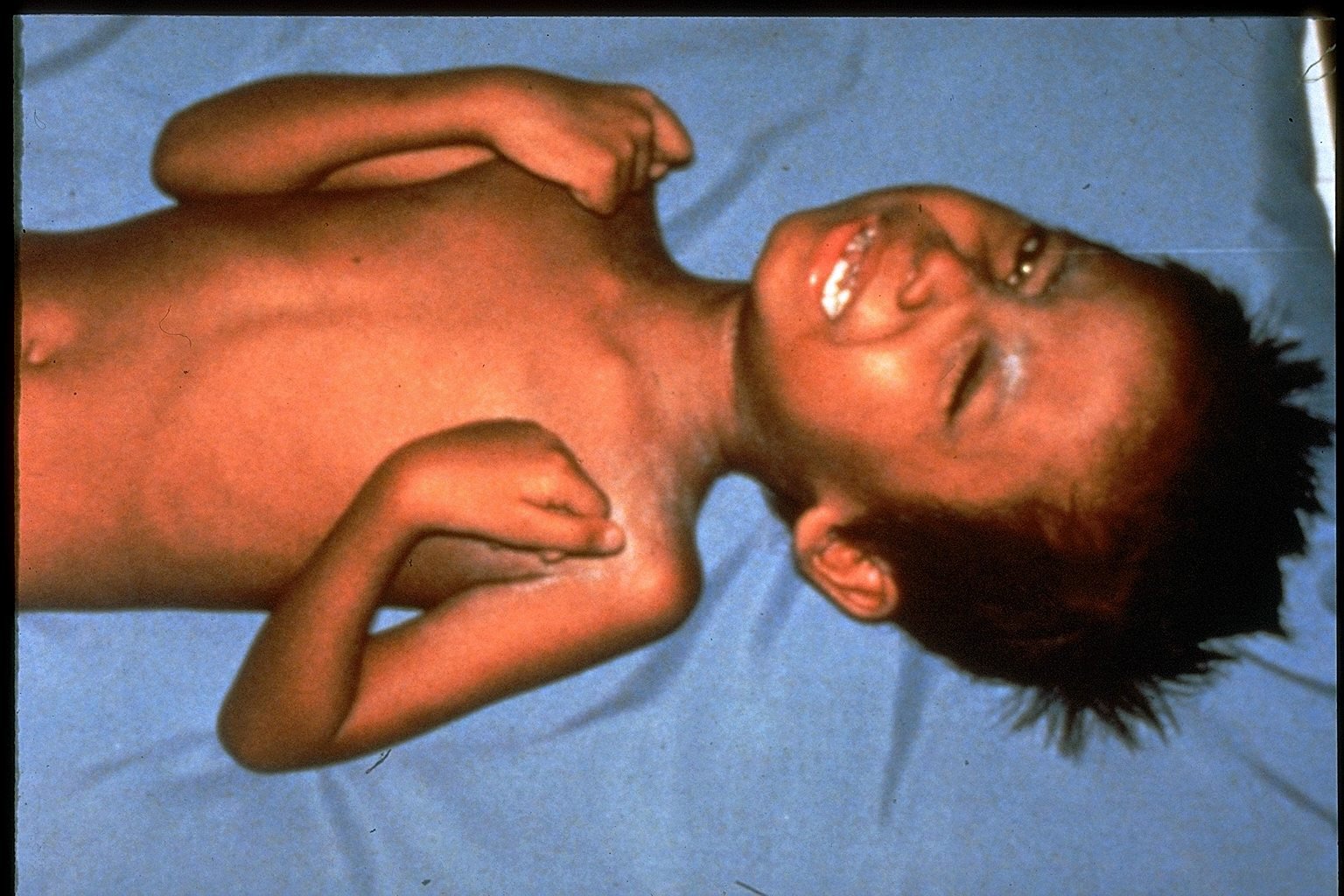
- ‘Lock jaw’ or trismus due to stiffness of the masseters which make the difficulty in opening mouth.
- Generalized muscle spasms, precipitated by external stimuli like touch, loud sounds, bright light etc.
- Difficulty in swallowing
- Restlessness
- Irritability
- Headache
- Neck rigidity
- Spasms of facial muscles
- Spasms and rigidity of muscles of back and neck make the body arch backward like a bow (opisthotonic position) constant spasm of the muscles of the extremities and abdomen
- Convulsion
- Tetanic spasm with clenching of jaws and hands,
- Spasm of laryngeal muscles with respiratory distress,
- Cyanosis and
- Over exhaustion.
Cephalic tetanus
- Paralysis of one or more of the cranial nerves (usually 7th) with gradual spastic manifestations-of whole body
Management of Neonatal Tatany/Child with Tetanus:
The specific management should aims at neutralization of the toxin and removal of the Cl. tetani.
- Human tetanus immunoglobulin 500 to 3000 IU should be given intramuscular immediate on admission to hospital. It is safest and most effective treatment without any complications.
- Anti-tetanic Serum (ATS) can be administered after skin test with 30,000 to 1,00,000 IU, .IM or IV.
- Antibiotic is administered and penicillin is the choice. Cephalosporin also can be used. Antipyretics is given to treat fever. Sedative and muscle relaxant is given with diazepam or phenobarbitone every 2 to 4 hours with calculated dose to control spasms.
- IV fluid therapy and oxygen therapy are essential.
- Mechanical ventilation may be needed in respiratory paralysis.
- Tracheostomy may be required in persistent laryngeal spasm.
(Ref: Paediatric Nursing, Parul Datta/34/236-237)
Nursing Management of Tetanus:
1. Supportive measures with special nursing care to be provided.
2. The patient should be placed in isolation in a separate quite room with complete rest and close observation.
3. Minimum disturbance and gentle handling to be maintained.
4. Suctioning of oropharyngeal secretions, comfortable positioning oxygen therapy, IV fluid therapy, hygienic measures and constant monitoring with recording of vital signs are important essential measures.
5. Initially oral feeding should be avoided and nasogastric tube feeding should be given.
6. Administration of medications should be done following specific precautions (e.g. skin test for penicillin).
7. Care of wound or injury or umbilical stump or ear discharge need special attention.
8. Special care to be taken for tracheostomy and for mechanical ventilation.
9. Pyridoxine therapy may give gratifying results in neonatal tetanus with conventional regimen.
(Ref: Paediatric Nursing, Parul Datta/34/237)
Complications of Tetanus:
| Respiratory complications: | Aspiration pneumonia Atelectasis Pneumothorax Mediastinal emphysema. |
| Cardiovascular complications: | Hypertension or hypotension Arrhythmia Myocarditis. |
| Miscellaneous; | Injury of tongue or oral mucosa Intramuscular hematoma and vertebral fracture during tetanic convulsions Fluid and electrolyte imbalance Malnutrition |
Prevention of Tetanus
Women of reproductive age (15-45 years)
| TT doses | Minimum interval between doses | Years protected |
| TT – 1 | 0 | 0 |
| TT – 2 | 4 weeks after TT-1 | 3 years (from 15 days after the administration ofTT – 2 ) |
| TT – 3 | 6 month after TT-2 | years (from 15 days after the administration of TT-3) |
| TT – 4 | 1 years after TT-3 | 10 years (from 15 days after the administration of TT-4) |
| TT – 5 | 1 years after TT-4 | lifelong protected |
Antenatal: Pregnant mother should be immunized with 2 doses of tetanus toxoid within 16-28 weeks of pregnancy.
Postnatal:
- Vaccine DPT at 6th, 10th and 14th weeks of birth.
- Booster dose: After 1 year

Tetanus prophylaxis in an injured patient: It depends on immunization status of wound, eg.
A) Clean wound:
a) Without previous immunization
- 1st dose Inj. TT 5 cc IM stat
- 2nd dose 6-12 weeks later
- 3rd dose after 6-12 months
- And booster dose every 5 years interval
b) Previously immunized but no booster dose within 5 years –
- Inj. TT 5 cc IM stat single dose
B) Tetanus prone wounds/Dirty wound:
- a) Non-immunizedPassive immunization with: Inj. TIG 250 unit IM stat
- Active immunization with: Inj. TT 5 cc IM state and repeat at 1, 2, 6 month
b) Immunized:
- Inj. TIG 250 unit IM stat