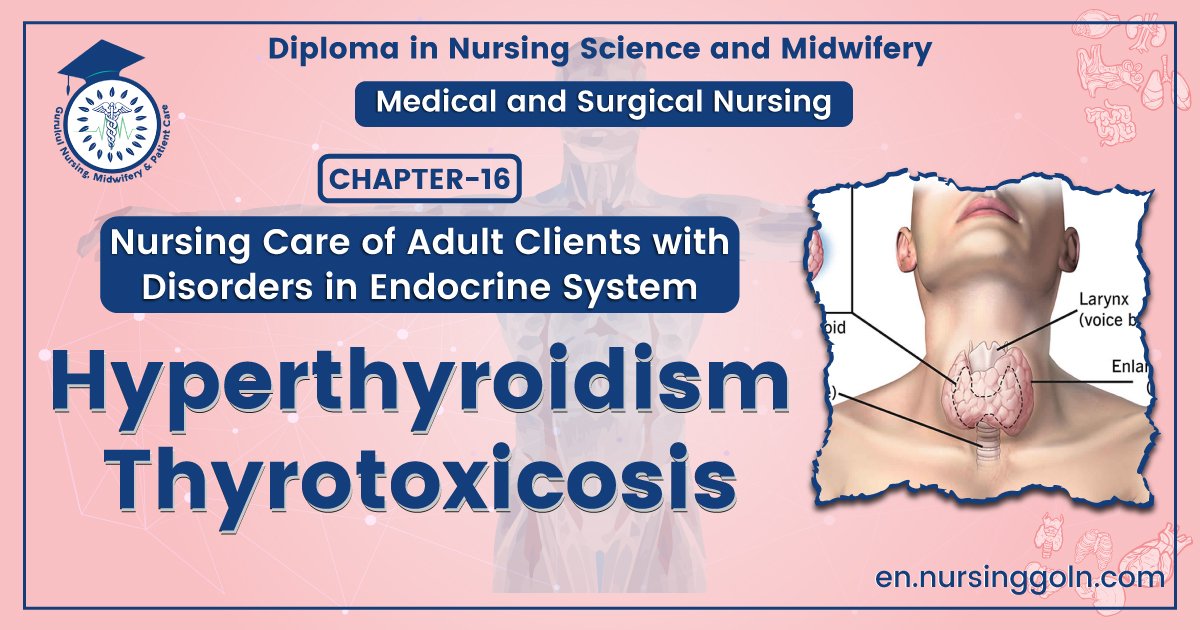
Concept of Hyperthyroidism / Thyrotoxicosis – This course is designed to understand the concept of community health nursing: nurses’ roles and interventions in family health, school health, occupational health, environmental health, elderly health care, gender issues, disaster management and principles and terminology of epidemiology. The aim of the course is to acquire knowledge and skills in community health nursing.
Concept of Hyperthyroidism / Thyrotoxicosis
Hyperthyroidism
A clinical syndrome due to excess circulating level of thyroid hormones due to thyroid gland’s hyperactivity
Or,
A clinical syndrome due to excess circulating level of thyroid hormones due to with or without thyroid gland’s hyperactivity or it is defined as a state of thyroid hormone excess.
(Ref by-Harrison’s 2233/21)
Causes of Thyrotoxicosis/ Hyperthyroidism:
1. Grave’s disease (76%)
2. Multinodular goitre. (14%)
3. Autonomously functioning solitary thyroid nodule. (5%)
4. Thyroiditis:(3%)
- Subacute (de Quervan’s)
- Post-partum
5. Iodide induced:
- Drugs (amiodarone)
- Radiographic contrast media
- Iodine prophylaxis programme
6. Extra-thyroid source of thyroid hormone:
- Factitious hyperthyroidism
- Stratum ovarii.
7. TSH-induced:
- TSH secreting pituitary adenoma
- Choriocarcinoma & hydatiform mole.
8. Follicular carcinoma metastases
(Ref: Davidson’s 740/22nd)
Note
Pathogenesis thyrotoxicosis:
1. For general:
- Thyroid stimulating immunoglobulin directed towards TSH receptors causes prolonged activation & excessive amount of T3 & T4 production.
2. For ophthalmopathy:
- Infiltration of extraocular muscle & skin by T lymphocyte. They activate the fibroblasts & causes deposition of glycosaminoglycan leading to water accumulation Ultimately fibrosis of the extraocular muscle & the eye is displaced forward results-proptosis & exophthalmos.
- Lid lag & lid retraction due to potentiation of sympathetic innervation of the levator palpebrae muscle.
Management of Thyrotoxicosis/Hyperthyroidism:
History:
- Female > Male.
- Age 20-50 yrs.
Clinical feature of thyrotoxicosis:
General
Symptoms:
- Weight loss despite normal increased appetite
- Heat intolerance
- Fatigue, apathy.
- Osteoporosis (fracture, loss of height)
Gastrointestinal:
- Diarrhoea, steatorrhoea, hyperdefecation
- Anorexia, & vomiting
Cardiorespiratory/cardiovascular:
Symptoms: Signs:
- Palpitations Sinus tachycardia
- Dyspnea on exertion Atrial fibrillation
- Angina Systolic hypertension
- Ankle swelling Cardiac failure.
Haematological:
- Lymphadenopathy
Neuromuscular:
Symptoms: Signs:
- Anxiety, irritability, emotional lability Tremor
- psychosis Hyper-reflexia
- Tremor III-sustained clonus
- Muscle weakness Proximal myopathy
- Periodic paralysis (predominantly in Chinese)
Dermatological:
Symptoms: Signs:
- Sweating Palmar erythema
- Pruritis Pretibial myxoedema
- Alopecia Finger clubbing (thyroid acropachy)
- Vitiligo
Reproductive:
Symptoms: Signs:
- Amenorrhoea/oligomenorrhoea Gynaecomastia
- Infertility, spontaneous abortion
- Loss of libido, impotence
Investigation
1. Thyroid function tests:
a) Total T & T :
- T4 & T3increased.
- TSH-decreased
b) Free T4 & T3
c) Radioactive iodine (113 I) uptake test.
2. Anti-thyroid antibodies
For Graves’ disease:
- TSI (TSH receptor antibody)
- Antimicrosomal /peroxidaseAb.
- Antithyroglobulin ab.
3. Thyroid scan, USG, FNAC.
4. Routine exam:
- Blood sugar:
- 2nd DM.
- Urine R/M/E.
- X-ray chest
- Cardiomegaly
- ECG (>40 yrs):
- Myocardial ischaemia.
- Atrial fibrilation.
- Ventricular hypertrophy.
X-ray neck lateral and A/P view :
- Retrosternal extension.
Scrum Ca++ level & bilirubin:
- Mild hypercalcaemia & raised bilirubin.
Serum enzymes:
- Raised ALT & alkaline phosphatase.
5. C-reactive protein.
Treatment
1. Drug therapy:
Antithyroid drugs:
Indication: First episode in pts < 40 yrs.
Carbimazole:
40-60mg per day for 3-4 weeks & then the dose can be reduced & titrated to maintain T4 & TSH within their reference range Maintenance dose 5-20 mg daily for 12-18 months accorrding tomeasurement of TSH & FT4
Propylthiouracil: It can be used I in pregnancy 400-600mg/day..
For symptomatic improvement:
Beta blocker:
Propranolol 160 mg daily or nadolol 40-80 mg in divided dose daily
2. Subtotal thyroidectomy:
- Patient must be euthyroid before operation.
- Antithyroid drug is stopped 2 weeks before surgery and replaced by potassium iodate 60mg 8 hourly daily orally.
Indication
- Large goitre
- Poor drug compliance, especially in young patients
- Recurrent thyrotoxicosis after course of antithyroid 1 drugs in young patient.
3. Radioactive iodine I therapy:
- Usually single dose but hyperthyroidism persists at 6 months a further dose is employed.
Indication
- Patients > 40 yrs
- Recurrence following surgery irrespective of age
- Other serious comorbidity
4. Specific treatment for Graves’ disease:
a. Ophthalmopathy:
- Usually no treatment other than reassurance.
- Methylcellulose eye drop & gel.
- Papilloedema, loss of visual acquity are treated with prednisolone.
- Diplopia, corneal ulcer require surgicall treatment.
b. Pretibial myxoedema: Local inj. triamcinolone
6. Thyrotoxicosis with fibrillation:
- Beta blocker: Propranolol 160 mg daily or nadolol 40-80 mg daily.
- Antithyroid drugs followed by radioactive iodine 113 1.
- For elderly-aspirin & warfarin for young
(Ref by: Davidson’s746/22nd+756-57/20th)
Pathophysiology of Thyrotoxicosis/Hyperthyroidism
Thyroid hormone T3 and T4 regulate energy metabolism growth to development
↓
Increase in thyrotoxicosis blood level T3 and T4
↓
Resulting increase metabolic rate
↓
Alter calorie genesis of protein fats and CHO
↓
Increase Symptomatic activities
↓
Thyrotoxicosis occur.