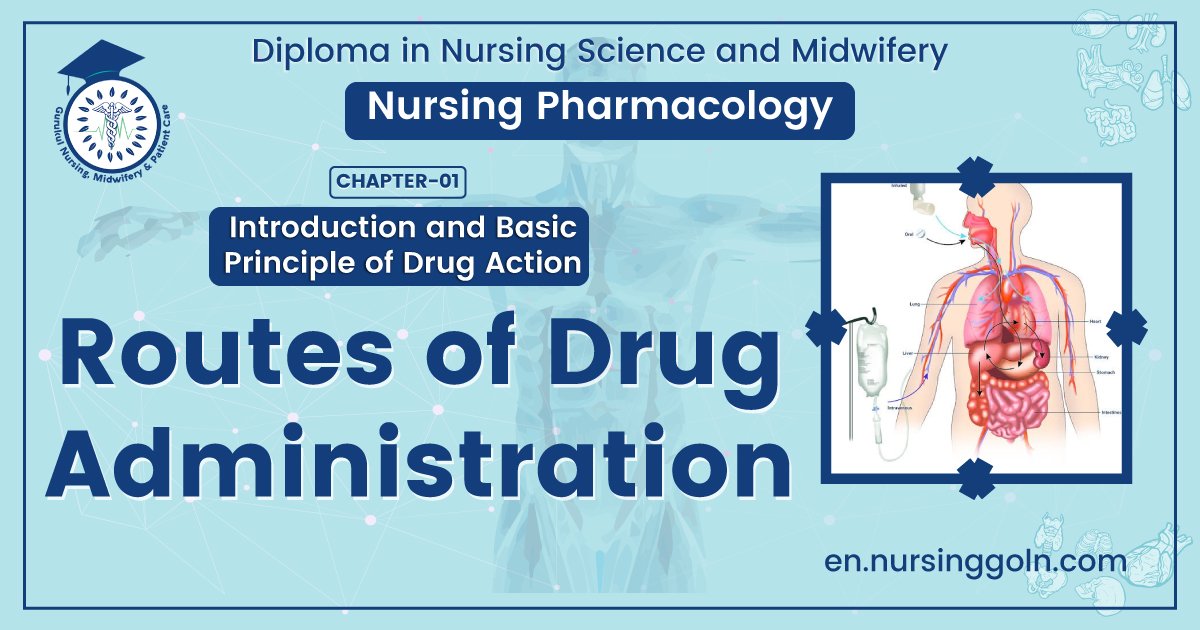
Routes of drug administration – This book covers the entire syllabus of “Pharmacology” prescribed by BNMC- for diploma in nursing science & midwifery students. We tried to accommodate the latest information and topics. This book is an examination set up according to the teachers’ lectures and examination questions.
At the end of the book, previous questions are given. We hope in touch with the book students’ knowledge will be upgraded and flourish. The unique way of presentation may make your reading of the book a pleasurable experience.

Routes of drug administration
The route of administration is determined by
1. The properties of the drug for example
- water or lipid solubility,
- ionization
2. The therapeutic objectives for example
- The desirability of a rapid onset,
- the need for long-term treatment,
- restriction of delivery to a local site
Definition of Drug Administration:
Medication administration is defined as preparing, giving and evaluating the effectiveness of prescription and non-prescription drugs.
Purposes of Drug Administration:
1. To prevent illness.
2. To treat illness.
3. To restore bodily functions.
4. To provide a medication that has systematic or local effect on gastrointestinal tract.
5. To prevent the disease.
6. To cure the disease.
7. To promote the health.
8. To give palliative treatment.
9. To give as a systematic treatment.
Patient Rights for Administration of Drug:
There are many ways to prevent medication errors and one way of which is understanding the 10 “rights” of drug administration:
| 1. Right Drug. |
|
| 2. Right Patient. |
|
| 3. Right Dose. |
|
| 4. Right Route. |
|
| 5. Right Time and Frequency. |
|
| 6. Right Documentation |
|
| 7. Right History and Assessment. |
|
| 8. Drug approach and Right to Refuse |
|
| 9. Right Drug-Drug Interaction and Evaluation. |
|
| 10. Right Education and Information. |
|

Routes of Drug Administration:
1. Systemic route
2. Local route
A. Systemic route:
a) Enteral or alimentary Route:
- Sublingual route
- Oral route
- Rectal route
b) Parenteral route (extra-intestinal)
Injection
- Subcutaneous (SC)
- Intracutaneous (IC)
- Intraarterial (IA)
- Intravenous (IV)
- Intramuscular (IM)
- Intraarticular (IArt)
- Intraperitoneal (IP)
- Intraventricular
- Intracardiac
- Intrapleural
Inhalation
- As a gas: e.g.: Volatile anaesthetic: N20, Chloroform
- As an aerosol: e.g. Beta 2 adrenoceptor agonist: Salbutamol (Bronchodilator)
- As a powder: e.g. Na chromoglycate
B. Local route:
Applied to the localized area and action is confined to that particular area.
a) Topical application: Ointment, paste, drops, powder, lotions etc.
- Skin inunction (by rubbing of drug on skin)
- To mucous membrane of nose, urethra, rectum, anal canal, vagina.
- To eye and ear.m
b) Iontophoresis: In this process the drug is applied to the particular area of skin and Galvanic current is used to increase absorption through skin.
Read more: