Function/Elements/Steps/Process of Management – This book covers the entire syllabus of “Leadership & Management” prescribed by the BNMC for Diploma in Nursing Science & Midwifery Students.
We tried to accommodate latest information and topics. This book is examination friendly setup according to the teachers’ lectures and examination’s questions. At the end of the book previous university questions are given. We hope in touch with the pook students’ knowledge will be upgraded and flourished. The unique way of presentation may make your reading of the book a pleasurable experience.

Function/Elements/Steps/Process of Management
Henry Fayol (1925) first identified the functions of management as:
- Planning
- Organization
- Command
- Coordination
- Control
Later Luther (1937) expanded these activities by introducing two more activities in addition. Planning, Organizing, Staffing, Directing, Co- coordinating, Reporting and in Budgeting (POSDECORB).
All these are again recognized by clubbing reporting and coordinating under the component of control and classified as five major elements or steps in the management process.
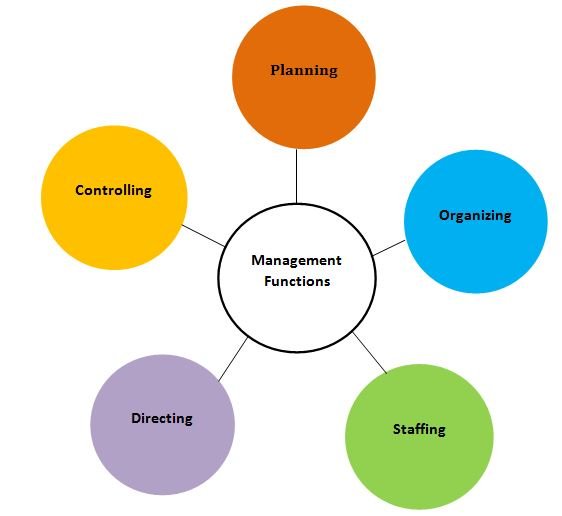
♦ Planning
“Planning is preparing a blue print”
Planning refers to thinking ahead of time and formulation of preliminary thoughts. In other words:
It is a continuous intellectual process of determining philosophy, objectives, policies, procedures and rules and standards, long and short-term projected outcomes and fiscal. course of actions and managing planned change. This is the preliminary and most important step of management process.
♦ Organizing
It is establishing the structure to carry out the plans: Determining the most appropriate type of patient care delivery in a health agency. Or educational programs in an institution In simple it is grouping the activities to meet its goal.
Other functions involve:
- Working within the structure of an organization.
- Understanding and
- Using power and authority appropriately.
♦ Staffing
It is a process of assigning competent people to fill the appropriate nursing roles in an institution, designated for the organizational structure though:
- Recruitment and selection of staff
- Hiring and orienting staff
- Staff scheduling and
- Staff development activities
- Staffing often becomes part of organizing.
Example
Appointment of a Dean for the college of nursing, nursing superintendent for a hospital or a head nurse for a hospital unit etc.
♦ Directing
Is a process of involving many human resource management responsibilities such as-
- Motivating
- Managing a conflict
- Communicating
- Facilitating collaborating and coordinating the tearn.
♦ Controlling
It is an ongoing process to ensure that the activities of an instruction or organization
adhere to the plan. It includes
- Quality assurance
- Performance appraisal
- Fiscal accountability
- Legal, ethical and professional control.
Definition of Nursing Management:
Nursing management is defined as the process of planning, organizing, activating and controlling the managerial function of nursing in order to determine and accomplish the objectives of nursing care.
Or,
Nursing management is the art of getting work done through and with nursing staff by the nurse manager. It is a cooperative effort aimed at providing high quality care to the patient.
Or,
In nursing management, the nurse manager or nurse administrator delegates the work load to the nursing staff with the authority and responsibility, and controls the work in a disciplined manner in order to achieve quality care and patient satisfaction.
Or,
Nursing management is an intellectual process in which the nurse manager plans, supervises, and coordinates the work of staff, reports to higher authority and responds to emergent situations in order to achieve high productive and quality patient care,
Or,
Nursing management is defined as the function of the nurse manager to forecast and plan, to organize and command, and to coordinate and control the activities or jobs done by the nursing staff in order to achieve their objectives in the provision of holistic care of the patient.
Characteristics/Nature of Management:
| Universal applicable: |
|
| Goal oriented: |
|
| An intangible process: |
|
| An distinct process: |
|
| A social process: |
|
| A decision making process: |
|
| An integrating process: |
|
| Guidance: |
|
| An art and science: |
|
| An economical resource: |
|
| A profession: |
|
| Authority: |
|
| Pervasiveness of planning: |
|
| A continuous process: |
|