
Study Design/ Research Design – In its most common sense, methodology is the study of research methods. However, the term can also refer to the methods themselves or to the philosophical discussion of associated background assumptions. A method is a structured procedure for bringing about a certain goal, like acquiring knowledge or verifying knowledge claims. This normally involves various steps, like choosing a sample, collecting data from this sample, and interpreting the data. The study of methods concerns a detailed description and analysis of these processes. It includes evaluative aspects by comparing different methods.
In this way, their benefits and drawbacks are evaluated, as well as the research goals for which they may be used. These descriptions and evaluations are predicated on philosophical background assumptions; examples include how to conceptualize the phenomena under study and what constitutes evidence in favor of or against them. In its broadest sense, methodology encompasses the discussion of these more abstract issues.

Study Design/ Research Design
Definition of Research Design
According to Kothari
“A research design is the agreement of conditions for collection and analysis of data in a manner that aims to combine relevance to the research purpose with economy in procedure”.
According to Nancy burns
“It is a blueprint for conducting a study that maximizes control over factors that could interfere with the validity of the findings”.
According to Hawghey
“Research design may be defined as Overall plan an investigator uses to obtain valid answers to research questions”.
According to Chris Jordan
“A research design is a blueprint for conducting the study that maximizes control over factor that could interfere with the validity of findings”.
(Ref by- Nirmala V/Research Methodology in Nursing/1/68)
Types of Study Design/ Research Design
Within both qualitative and quantitative approaches, there are several types of research design to choose from. Each type provides a framework for the overall shape of your research.
Types of quantitative research designs
Quantitative designs can be split into four main types.
Experimental and quasi-experimental designs allow you to test cause-and-effect relationships, while descriptive and correlational designs allow you to measure, variables and describe relationships between them.
| Type of design | Purpose and characteristics |
| Experimental |
|
| Quasi- experimental |
|
| Correlational |
|
| Descriptive |
|
Types of qualitative research designs
Qualitative designs are less strictly defined. This approach is about gaining a rich, detailed understanding of a specific context or phenomenon, and you can often be more creative and flexible in designing your research. The table below shows some common types of qualitative design. They often have similar approaches in terms of data collection, but focus on different aspects when analyzing the data.
| Type of design | Purpose and characteristics |
| Case study |
|
| Ethnography |
|
| Grounded theory |
|
| Phenomenology |
|
Types of Research Design
Research design may be classified as-
1. Non-experimental designs
2. True experimental designs
3. Quasi experimental designs
| Types of non-experimental designs: | Post-test only design (also known as prevalence study or situation analysis study) Pre-test, post-test design Static group comparison design |
| Types of True experimental designs: | Post-test only control group design Pre-test, post-test control group design |
| Types of Quasi experimental designs: | Time series design Separate sample pre-test, post-test design Non-equivalent group comparison |
(For EQ)
Non-experimental designs:
➤ Post-test only design:
- This is the weakest design that fails to control adequately the various threats to internal validity.
- This design is useful for collecting descriptive information or doing small case studies of a particular situation.
- Example: UNICEF, Bangladesh introduced a lipidol injection campaign in certain IDD prone areas of Bangladesh. A year later, a measurement was taken from those who received the injection resulting in the observation
➤ Pre-test Post-test design:
- This design include a single experimental group. There is no control group; since there is no control group with which to measure extraneous variation, it can only be used when the experimenter assume that the extraneous variation is minimal.
- Example: In the measurement of glucose level, blood sample is taken and glucose level determined. This is pre-test. Two hours after administering glucose or breakfast, a second measurement is taken. This is the post-test.
➤Static group design
- In this design, subjects are identified either as experimental group or control group. The experimental group is measured after it has been exposed to the experimental treatment.
True Experimental Design:
➤Post-test only control group design:
- In this design, the pre-test measurement of both the groups are omitted. Pre-test are well established in classical research design but are not really necessary when randomization process is followed.
➤ Pre-test post-test control group design:
- It is a design in which all subjects are randomly assigned from a single population to the experimental group and the control group
Quasi experimental designs:
➤ Time series design:
- It involves a series of measurements at periodic intervals before the program begins and continuing measurements after the program ends.
➤ Separate sample pre-test, post-test design:
- This design is most applicable when we cannot know when and whom to introduce the treatment but we can decide when and whom to measure.
➤ The Nonequivalent Groups Design
- The Non-Equivalent Groups Design (hereafter NEGD) is probably the most frequently used design in social research.
- It is structured like a pre-test, post-test randomized experiment, but it lacks the key feature of the randomized designs – random assignment.
Comparative outline for the three types of research designs:
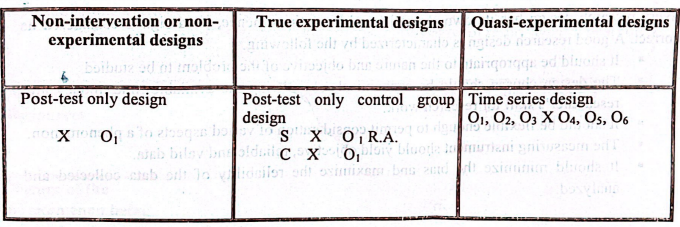
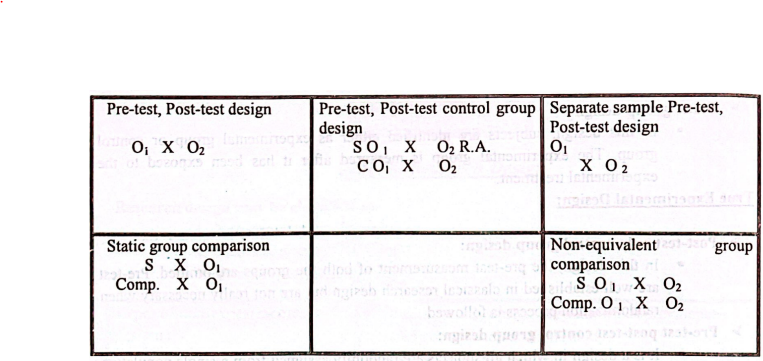
Keys:
➤ 0 : Observations or data collected from observations
➤ X : A situation prevailing or an event or exposure that has Occurred or an intervention programme introduced or experiment done
➤S : Study group
➤C : Matched control group
➤Comp : Comparison group, not necessarily matched
➤R.A : Random assignment or allocation of selected sampling units of study or control group
(Ref by- Sadeka Tahera Khanom/Research Methodology/24/48 and handout)
Characteristics of Research Design:
Every research design has its own strengths and limitations, hence, no design is considered as correct. A good research design is characterized by the following: It should be appropriate to the nature and objective of the problem to be studied.
- The design chosen should be economical, considering the available time, money and researcher’s skill for research work.
- It should be flexible enough to permit consideration of varied aspects of a phenomenon.
- The measuring instrument should yield objective, reliable and valid data.
- It should minimize the bias and maximize the reliability of the data collected and analyzed.
- The information should be obtained from requisite size of the sample, which is selected by appropriate sampling technique.
- It ensures appropriate statistical analysis for processing data.
- It should ensure generalization of the findings of the present study.
(Ref by- Nirmala V/Research Methodology in Nursing/1″/68)
Purposes of Research Design:
- Research design prescribes boundaries of research activities and therefore it facilitates effective and economical way of tackling various research problems.
- It is blueprint prepared in advance based on the objectives of the study, to enhance orderliness in data collection and analysis.
- It helps the researcher to organize his ideas and evaluate the projected study.

Factors influencing the choice of Research Design
| Researcher’s knowledge | Researcher’s knowledge about the phenomenon to be studied affects the choice of research design, |
| Researcher’s experience | Researchers experience and interest are to be considered while deciding the design of the study |
| Availability of Time | Availability of adequate time for problem identification, its analysis and finally for interpretation of results plays a vital role in the choice of research design. |
| Availability of Resources | The selection of research design is determined by the availability of resources like man power, money and materials needed for research |
| Nature of the phenomenon being studied | Whether, the phenomenon, to be studied in a naturalistic, or non-naturalistic way, is an important concern in choosing how to study it. |
| Precision Required | Precision refers to the ability to obtain the most accurate estimate of a single variable. |
| Ethical consideration | The choice between an experimental and non-experimental design must be made, while taking ethics into considerations. |
| Degree of control | An efficient design should maximize results, reduce bias and control other factors that are known to influence the variables of interest and outcome of the study. |
(Ref by-Nirmala V/Research Methodology in Nursing/1″/69)
Steps for developing research design
- Classify the intended outcome of what needs to be understood
- Developing the research question
- What needs to be measured
- Select the population for the experiment
- Identify the ideal data collection method
- Construct Interrelated characteristics
- Use correct analysis tools
- Choose a channel for disseminating your firidings
Elements/Components of Research Design
The essential elements of research design are:
1. Accurate purpose statement of research design
2. Techniques to be implemented for collecting details for research
3. Method applied for analyzing collected details
4. Type of research methodology
5. Probable objections for research
6. Settings for research study
7. Timeline
8. Measurement of analysis