Definition of Jaundice –Nursing is a profession within the healthcare sector focused on the care of individuals, families, and communities so they may attain, maintain, or recover optimal health and quality of life. Nurses may be differentiated from other healthcare providers by their approach to patient care, training, and scope of practice. Nurses practice in many specialisms with differing levels of prescriber authority.
Many nurses provide care within the ordering scope of physicians, and this traditional role has shaped the public image of nurses as care providers. However, nurses are permitted by most jurisdictions to practice independently in a variety of settings depending on training level. In the postwar period, nurse education has undergone a process of diversification towards advanced and specialized credentials, and many of the traditional regulations and provider roles are changing.
Nurses develop a plan of care, working collaboratively with physicians, therapists, the patient, the patient’s family, and other team members, that focus on treating illness to improve quality of life. Nurses may help coordinate the patient care performed by other members of an interdisciplinary healthcare team such as therapists, medical practitioners, and dietitians. Nurses provide care both interdependently, for example, with physicians, and independently as nursing professionals.

Definition of Jaundice
Definition:
Jaundice may be defined as yellow coloration of the skin, mucous membrane and sclera due to excess bilirubin in the blood. Normal range of bilirubin: 0.3 to 1 mg/dl of blood.
Or,
Jaundice may be defined as yellow discoloration of the skin, sclera and mucous membranes due to an increased bilirubin concentration in the body fluid above normal.
Classification of jaundice:
➤ Hemolytic Jaundice. spherocytosis. Causes: Thalassemia, sickle cell anemia, hereditary
➤ Hepatocellular Jaundice. Causes: Acute and chronic hepatitis.
➤ Obstructive jaundice. Cause: stone impact in the common bile duct etc.
Another Answer
Classification of jaundice with causes:
Pathophysiological classification:
➤ Predominantly unconjugated hyperbilirubinaemia:
- Excess production of bilirubin: e.g. haemolytic anaemia, resorption of blood from internal haemorrhage (e.g. haematoma, GIT bleeding).
- Reduced hepatic uptake: e.g. Gilbert syndrome.
- Impaired bilirubin conjugation: e.g. physiological jaundice of the newborn.
➤ Predominantly conjugated hyperbilirubinaemia: Intrahepatic & extrahepatic cholestasis.
Clinico-pathological classification:
➤ Haemolytic/prehepatic jaundice:
- Congenital defect in RBC haemoglobinopathies. e.g. sickle cell anaemia, thalassaemia,
- Certain infection, e.g.- malaria.
- Certain drugse.g.- quinine.
- Snake venom.
- Incompatible blood transfusion.
- Erythroblastosis foetalis.
➤ Hepatocellular / hepatic jaundice:
- Viral hepatitis.
- Chronic alcoholic hepatitis.
- Liver cirrhosis.
- Infections: Yellow fever, septicaemia.
- Poisons – arsenic, chloride.uni
➤ Obstructive/post-hepatic jaundice:
- Intrahepatic cholestasis: Drug induced, alcohol, primary biliary cirrhosis, viral hepatitis etc.
- Extrahepatic cholestasis:
✓ Impaction of gall stone in common bile duct.
✓ Carcinoma of head of pancreas.me
✓ Metastatic carcinoma of common bile duct. ✓ Stricture of common bile ductus noluita edt nwab ata/0
✓ Ascaris impaction in common bile duct.que no li woll
✓ Pressure from outside by enlarged coeliac lymph nodes.
Investigation for jaundice assessing liver function:
1. Estimation of serum bilirubin
2. Estimation of serum alkaline phosphatase.
3. Estimation of serum transaminase (SGOT, SGPT).
4. Estimation of serum albumin & prothrombin time.
(Ref: Wright’s, 13/45p)
Clinical features of hemolytic jaundice:
- ↑ Serum bilirubin (Unconjugated).
- ↑ Urobilinogen in urine.
- Vanden Bergh test positive (Indirectly).
- Stool is excessive yellow.
- Liver function is normal.
- Nice to Know
Normal serum bilirubin: 0.3-1 mg/dl (5.1-17 µmol/L).
Clinical jaundice: When bilirubin in plasma exceeds 2-2.5 mg/dl (50 µmol/L)
Latent jaundice: Clinically there is no jaundice but serum bilirubin is more than normal and < 3mg/dl.
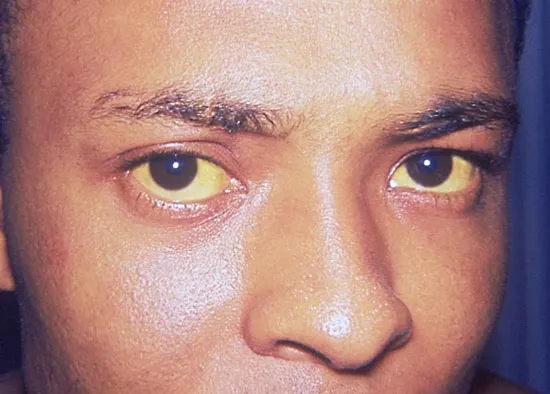
Site of Examination of Jaundice:
- Upper sclera.
- Undersurface of tongue,
- Face.
- Palms.
- Sole.
- As a whole skin (especially in fair-skinned individual).
C/F of Jaundice:
- Yellow tinge to the skin and the whites of the eyes, normally starting at the head and spreading down the body
- Pruritis (itchiness)
- Fatigue
- Abdominal pain – typically indicates a blockage of the bile duct
- Weight loss
- Vomiting
- Fever
- Paler than usual stools
- Dark urine