Classical conditioning – Behavioral sciences explore the cognitive processes within organisms and the behavioral interactions between organisms in the natural world. It involves the systematic analysis and investigation of human and animal behavior through the study of the past, controlled and naturalistic observation of the present and disciplined scientific experimentation and modeling.
It attempts to accomplish legitimate, objective conclusions through rigorous formulations and observation. Generally, behavior science deals primarily with human action and often seeks to generalize about human behavior as it relates to society.
Classical conditioning
Concept of Classical Conditioning:
The study of classical conditioning began in the early years of the 20th century when Ivan Pavlov (1849-1936) a Russian physiologist who had already won the Nobel Prize (1904) for research on digestion, turned his attention to learning. While studying digestion, Pavlov noticed that a dog began to salivate at the mere sight of the food dish. Pavlov decided to see whether a dog could be taught to associate food with other things, such as a light or a tone.
Definition of Classical Conditioning:
Classical conditioning (also known as Pavlovian or respondent conditioning) refers to a learning procedure in which a biologically potent stimulus (e.g. food) is paired with a previously neutral stimulus (e.g. a bell).
or
A type of learning, in which a neutral stimulus comes to bring about a response after it is paired with a stimulus that naturally brings about that response.
Principles of Conditioning:
The principles of classical conditioning can be used in the following areas of animal and human learning:
1. Developing good habits: Good habits such as cleanliness, respect for elders, and punctuality, etc. can be brought about by using principles of classical conditioning.
2. Breaking of bad habits and elimination of conditioned fears: All learning is acquired in the social environment. Acquired learning may be deconditioned by using the principles of classical conditioning, e.g. for deconditioning anxiety and fear in maladjusted children.
3. Training of animals: Animals trainers have been using the principle of classical conditioning and operant conditioning for long without being aware of the underlying mechanism.
4. Use in psychotherapy: In deconditioning emotional fears in mental patients.
5. Used to develop favorable or unfavorable attitude towards learning, teacher and the school.
Pavlov’s Experiment of Classical Conditioning:
In Pavlov’s experiment, a researcher first attached a capsule to a dog’s salivary gland to measure salivary flow. A bell was rung, every time, the dog Sam was given the meat powder. This was repeated several times. Later Pavlov observed that the dog salivated at the mere sound of the bell, without the meat powder being followed. Thus, the dog had been conditioned to respond to a new stimulus which was previously an unconditioned response.
The meat powder is the unconditioned stimulus (UCS); salivation is the unconditioned response (UCR) sound of the bell is the conditioned stimulus (CS) and salivation at the sound of the bell is the conditioned response (CR).
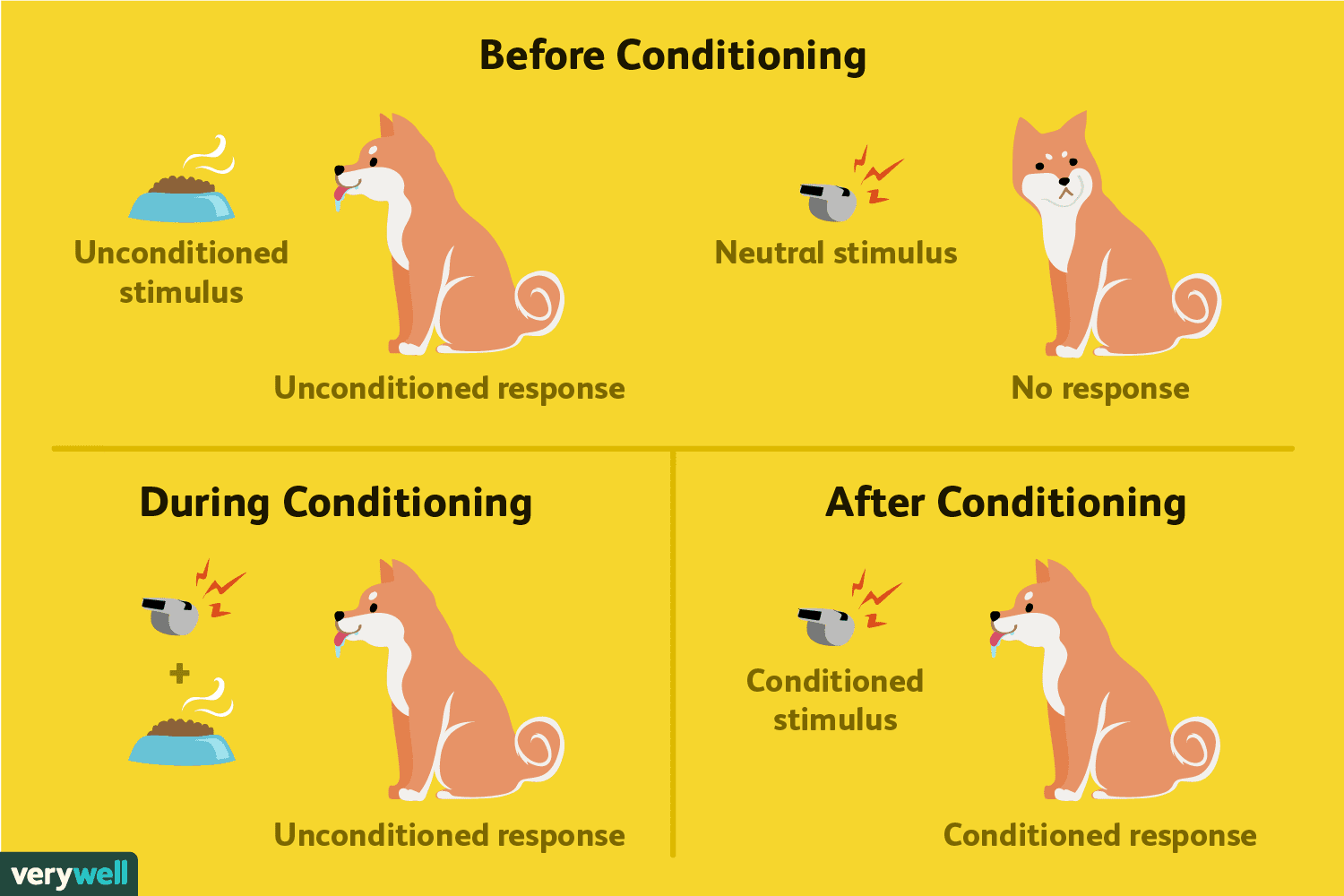
Pavlov’s theory is that CS (bell) simply as a result of pairing with the UCS (meat powder) acquires the capacity to substitute for the UCS in evoking the response. This means that an association is formed between the CS and the UCS, so that CS becomes the equivalent of the UCS in eliciting response.
Pavlov believed that this association took place in the brain. Two areas of the brain, one for the UCS and the other for the CS became activated during classical conditioning and the activation of UCS area resulted in a reflex or automatic response. Pavlov showed us how a significant internal process such as learning can be studied objectively.
Operant or Instrumental Conditioning:
Instrumental conditioning is associated with the works of EL Thorndike (1874-1947) and BF Skinner (1904-1990). Thorndike was the first to conduct laboratory experiments (1898) on operant conditioning leading to the formulation of the law of effect which formed the basis of the principle of reinforcement. But it was Skinner who made operant conditioning popular with experiments on pigeons, rats and human beings.
Skinner placed a rat inside a glass box (Skinner box) containing a lever and food tray. The animal was free to explore the box. Whenever the lever in the box was pressed, automatically a pellet of food was dropped on the tray. By a mechanical device the number of times the rat pressed on the lever was recorded, Pressing of the lever was the, response to be learned (the operant response) and the food was the stimulus consequence (reinforcement).
The rate of presses increased notably with the rewarding of the rat with food each time he pressed the lever. By reinforcement the rat learned the instrumental response. Reinforcement can be either positive (reward) or negative (punishment).
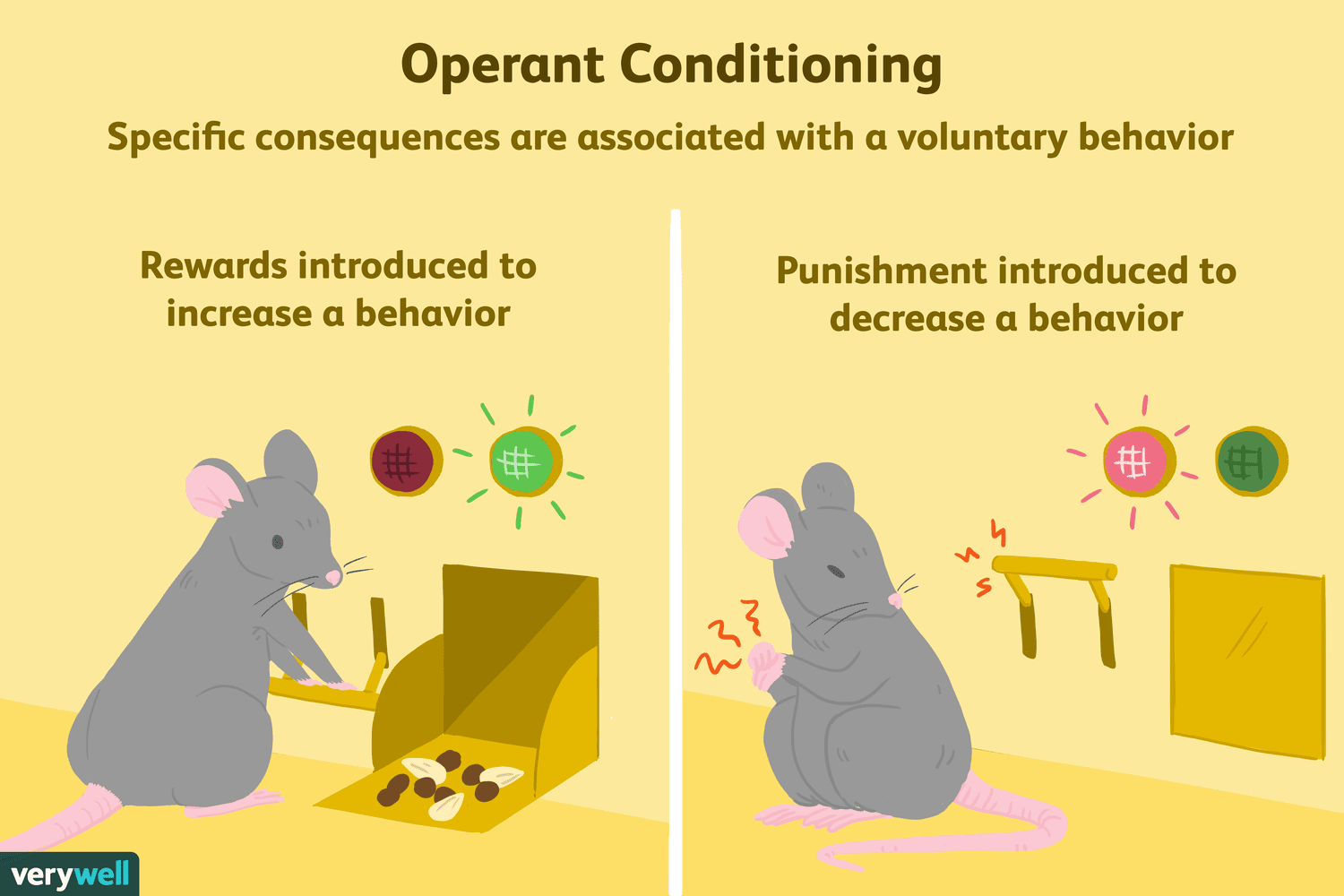
Operants are actions which animals and human beings do like walking, smiling, watching televisions, etc. The learner has to “operate” on his environment. The term “instrumental” points to the fact that the learner has some control over his circumstances. His action is instrumental to what happens to him.
Instrumental conditioning involves more activity on the part of the learner than classical conditioning. Generally, behavior directed towards gaining a reward or avoiding a punishment are examples of instrumental action. Intention and achievement are important in this kind of learning.
Difference between Classical Conditioning and Operant Conditioning:
| Classical conditioning | Operant conditioning |
| 1. Response is emitted or not, the UCS will be presented | 1. Response is elicited (the learner does not see the food (stimulus) |
| 2. Time interval between CS and the UCS is rigidly fixed | 2. Time interval depends on the organism’s own behavior |
| 3. The unconditioned stimulus (UCS) occurs without regard to the subject’s behavior | 3. The reward is contingent upon the occurrence of response (reinforced by food) |
| 4. Association between stimulus response (SR) is on the basis of law of contiguity (things occurring closer in time and space get associated) | 4. Association between stimulus responses (SR) is on the basis of law of effect (effect of reward and punishment) |
| 5. There is pairing of UCS and CS (response is emitted in the absence of stimulus) | 5. No pairing of UCS and CS but pairing of a response and the reinforcing stimulus which follows |
| 6. Reinforcement comes first as food is presented first to elicit the response | 6. Reinforcement is provided after the response is made by the organism |
| 7. (UCS) unconditioned stimulus is presented regardless of whether the (CR) conditioned response occurs | 7. Stimulus is presented only if the organism makes the desired response |
| 8. Stimulus oriented (stimulus is conditioned) | 8. Response oriented (response is conditioned) |
| 9. Essence of learning is stimulus substitution | 9. The essence of learning is response modification |
| 10. Involuntary response (saliva flows automatically) | 10. Voluntary response (knowledge-mind) |
| 11. Involves autonomic nervous system | 11. Involves central nervous system |
| 12. Organism is passive | 12. Organism is active |
Cognitive Theory of Learning:
In more complex forms of learning, perception and knowledge or cognition processes play the vital role. According to cognitive theorists, learning cannot be explained in terms of S-R (stimulus-response) association alone.
They propose that a learner forms a cognitive structure in memory which organizes information into relationships and meanings without any known reinforcement. New associations are formed and new relationships are perceived along events, simply as a result of having experienced these events. Links are made among stimuli, so that stimulus-stimulus (S-S) associations are learned.
Theory of Learning by Insight (Gestalt psychology):
It was developed by a group of Gestalt psychologists, Kurt Koffka, Wolfgang Kohler and Max Wertheimer who concluded that the individual learns by his ability known as insight and not by blind trial and error. According to them, a person can deduce the solution by insight if he perceives the situation as a whole. The situation viewed as a whole will definitely look different from that viewed through its parts.
The whole of an object or situation is not merely the sum total of its parts like water is quite different from its elements hydrogen and oxygen. Sum total of the parts may create a new entity which is called as Gestalt. The emergence of a Gestalt, produces in an individual an insight into the problem.
The most famous experiments conducted by Kohler (1887-1967) relation to insight were those conducted with a chimpanzee called Sultan. Some bananas were placed inside the cage of hungry Sultan who was then given two sticks so constructed that they could be fitted together.
The hungry Sultan tried to get the bananas by extending out his hands. Then he took up one of the sticks and tried to pull the bananas, an effort which he kept up for one hour. Then he got tired and started to play with the sticks. Meanwhile, one end of one stick got incidentally fastened into the ring fixed on the end of other stick with the result that both the sticks were joined together. Now Sultan used this joined stick to pull in the bananas and succeeded.
The Gestalt psychologists made a number of such experiments and concluded that individuals learn by insight which emerges suddenly as a result of perceiving the situation as a whole. Sultan’s sudden learning was due to insight developed from his perception of the total situation consisting of the cage, sticks and bananas as a whole.
The gestalists tried to interpret learning as a purposive, exploratory anu cicaure enterprise instead of trial and error or simple stimulus response mechanisms.
Characteristics of Learning by Insight:
1. Insight is sudden.
2. Insight is due to understanding.
3. Insight alters perception.
4. Old objects appear in new patterns and organization due to insight.
5. Higher species of animals including man has more insight than members of lower species.
6. Insight develops usually after some trial and error.
7. Previous experience is of assistance to insight.
8. Maturity also helps insight as shown by the smoother working of insight in older age than in adolescents.
9. If pieces essential for the solution of the puzzle are presented together when perceived, insight comes about earlier.

Tolman’s Theory of Sign Learning:
According to Tolman (1930) learning is a total process. It takes place by cognition. Cognition includes concepts like knowledge, thinking, planning, inference and purpose.
The learner through his experience recognize some cues or signs and then relationships with goals. Learning consists in the recognition of signs and their meanings in relation to goals.
Tolman argued that the organism follows certain signs and clues to reach a goal. It learns its ways by following a sort of mental map and it does not learn only some movements but also their significance and meanings. Hence, this theory is called sign learning theory.
According to Tolman, during goal directed behavior, cognitive maps are formed which are used to reach the goal.
In a typical experiment by investigators in sign learning, a comparison was made between two groups of hungry rats in a maze. In one group, each subject received food each time it ran the maze and steady improvement was noticed. In the other, each subject was given access to the maze without finding a food reward and little improvement occurred in time or error scores.
However, when food was introduced at the tenth trial, performance soon approximated that of the group which had been rewarded J continually. Such sudden improvement suggests that the animals had acquired information about the maze which they did not utilize until, after the tenth day it became advantageous for them to do so. The rats had developed a cognitive map of the maze.