Levels of Organization in Biology – Introduction to fundamental concepts of Biological Science including the organization and common characteristics of living matters, cell structures and functions, food production by photosynthesis, harvesting energy, mechanism of cells reproduction, genetics, evolutions, and Human Biology. Introduction to general chemistry including basic concepts about matter, atomic structure, chemical bonds, gases, liquid, and solids, solutions, chemical reactions, acid, bases, and salt;
organic and biochemistry including hydrocarbons and their derivatives, carbohydrates, lipids, proteins, enzymes, vitamins, and minerals, nucleic acids; principles of physics and applications to nursing including gravity and mechanics, pressure, heat and electricity; nuclear chemistry and nuclear physics, effects of radiation on human beings, and protection and disposal. The aim of the course is to acquire knowledge and skills in general biological science, general chemistry and physics.
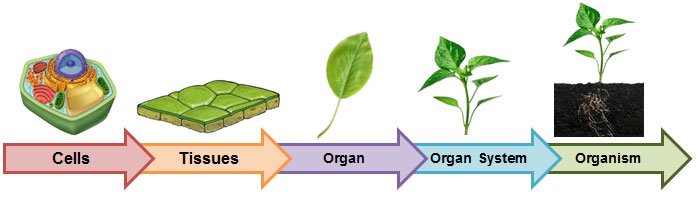
Levels of Organization in Biology
Molecule
Molecules are made of atoms, the smallest unit of chemical elements. They can be found in all matter, living and non-living. Molecules make up the most basic structures of living beings. Two biological disciplines that focus on this level are biochemistry and molecular biology.
Cell
A cell is the basic unit of life. There are two kinds of cells: plant cells, which have a rigid cell wall made of cellulose molecules, and animal cells, which have flexible cell membranes. Cell biologists consider questions such as metabolism and other questions about structure and function within and between cells,
Tissue
Tissue is made of cells that work together to perform a certain task. Muscle tissue, connective tissue, and neural tissue are some types of tissue. Histologists are an example of biologists who work at this level.
Organ
An organ is a system of tissues that work together on a larger scale to do certain jobs within an animal’s body. Examples of organs are the brain, heart and lungs. Anatomy is an example of a biology specialty concerned with this level.
Organ System
An organ system is a group of organs that work together to perform specific bodily functions. The respiratory system, for example, uses the lungs, airways and respiratory muscles to inhale oxygen and release carbon dioxide in animals. Physiologists study the function of parts of the body as they work together. Though physiologists can work at any level of biological organization, they often answer questions related to organ systems.
Organism
An organism is a recognizable, self-contained individual. Organisms can be unicellular organisms such as bacteria or amoebae, or multi-cellular organisms comprised of organs and organ systems. A human being is an example of a multi-cellular organism.
Difference Between Living Things and Non-Living Things:
| Traits | Living Things | Non-Living Things |
| Meaning | Living things are the creatures that are alive and compose of tiny particles, i.e. cells. | Non-living things refers to those objects or items, that do not exhibit any sign of life. |
| Organization | Highly organized | No such organization |
| Consciousness | They sense things and react to external stimulus | Non-living things do not sense things |
| Homeostasis | Maintain a stable internal environment to make cells function. | Do not maintain a stable internal environment. |
| Metabolism | Reaction like anabolism and catabolism occurs. | No metabolic changes occur in non- living things. |
| Growth | All living things undergo a regulated growth. | Non-living things do not grow. |
| Evolution | Living things go through evolution. | Non-living things do not undergo evolution. |
| Survival | Depends on food, water and air for survival. | Does not depend on anything for survival. |
| Life-span | Have a certain life span, after which they die | There is no such thing like life span. |