Active Immunity and Passive Immunity – Basic microbiology, parasitology, and immunology; nature, reproduction, growth, and transmission of common microorganisms and parasites in Bangladesh; prevention including universal precaution and immunization, control, sterilization, and disinfection; and specimen collections and examination. Students will have an understanding of common organisms and parasites caused human diseases and acquire knowledge about the prevention and control of those organisms.
Active Immunity and Passive Immunity
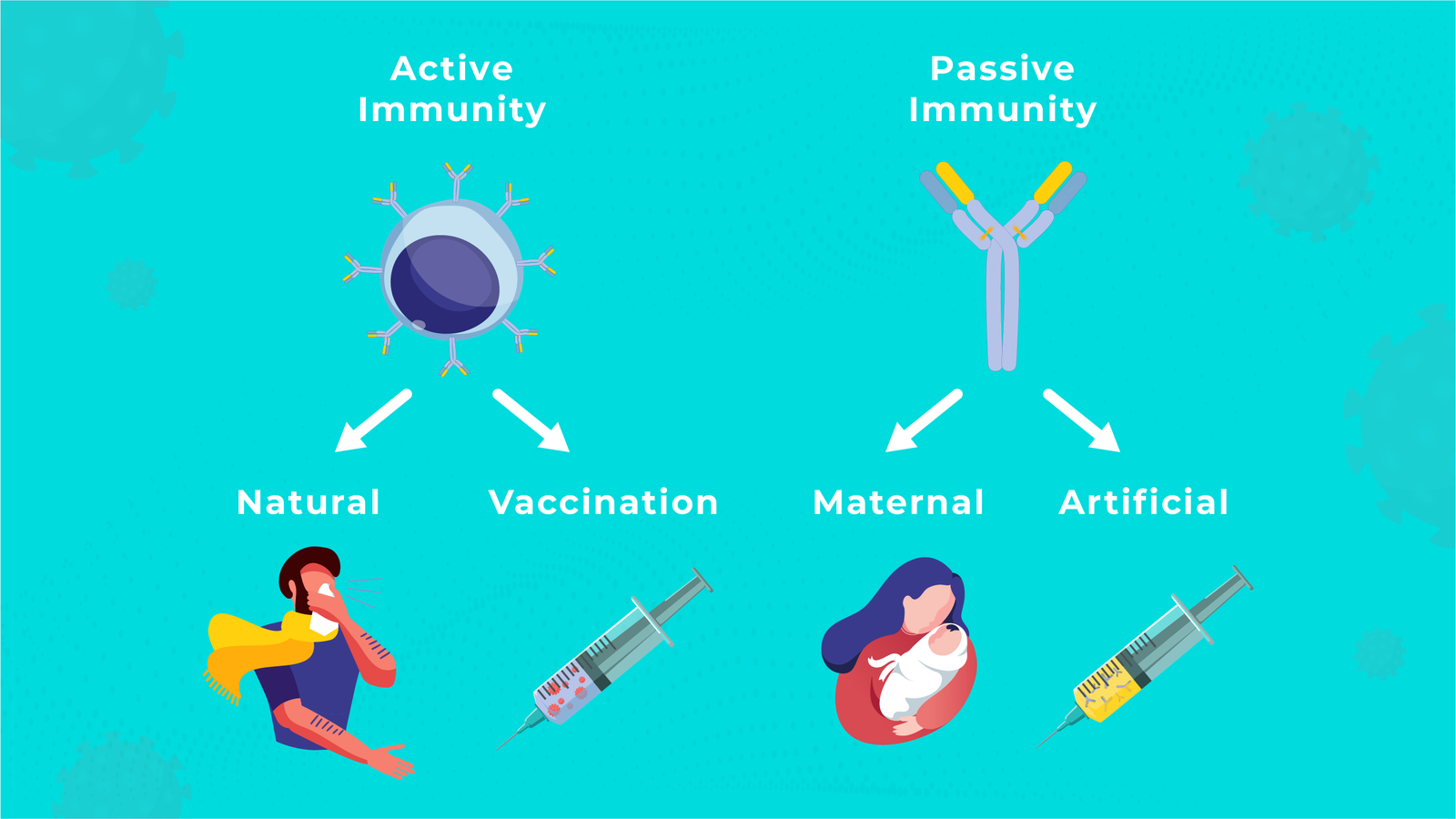
Active immunity
Active immunity involves the production of antibodies by the body itself and the subsequent development of memory cells.
Examples of Active Immunity
a) Natural – Producing antibodies in response to exposure to a pathogenic infection (i.e. challenge and response)
b) Artificial – Producing antibodies in response to the controlled exposure to an attenuated pathogen (i.e. vaccination)
Passive immunity
Passive-immunity results from the acquisition of antibodies from another source and hence memory cells are not developed.
Examples of Passive Immunity
a) Natural – Receiving antibodies from another organism (e.g. to the foetus via the colostrum or a newborn via breast milk)
b) Artificial – Receiving manufactured antibodies via external delivery (e.g blood transfusions of monoclonal antibodies)
Active immunity will result in long-term immunity but passive-immunity will not (due to the presence or absence of memory cells)
Both active and passive-immunity can be induced by either natural or artificial mechanisms.
Active immunity is superior to passive immunity due to-
- Protection is long lasting
- No risk of hypersensitivity reaction
- Develop immunological memory
- Less expensive
- More effectiveness
- Mild side effects
- Prevention of disease
Host Resistance against Infections
Active immunity
- It is that type of acquired immunity where immune -competent cells of body participate actively.
- It is the immunity which is developed in an individual as a result of infection or specific immunization.
- Here the individual produces actively the antibodies or effectors T cell after contact with foreign antigen.
Active immunity may be acquired in 3 ways
a) Following clinical infection e.g. /Chicken pox, /Rubella / Measles to
b) Following subclinieal or inapparent infection e.g. Polio & Diphtheria.
c) Following immunization with an antigen may be / Killed vaccine /a live attenuated vaccine or toxoid.
Passive immunity
When antibodies produced in one body are transferred to another to induce protection against disease. It is known as passive-immunity.
Or
It is that type of acquired immunity where the antibody is introduced into a host to produce a specific immunity
Passive immunity may be developed in following ways
a) By administration of antibodies containing preparation (Immunoglobuliin or antiserum)
b) By transfer of maternal antibodies across the placenta.
c) By transfer of maternal antibodies (IgA) via colostrum to foetus,
d) By transfer of lymphocytes, to induces passive cellular immunity.
Active Immunity is Produced in Three Ways
- Following clinical infection -> e.g., chickenpox, rubella and measles.
- Following subclinical or in-apparent infection -> e.g., polio and diphtheria.
- Following immunization with an antigen -> which may be a killed vaccine, a live.
Difference Between Active & Passive Immunity
| Traits | Active Immunity | Passive Immunity |
| Active participation by host | Yes | No |
| Onset of action | Immunity starts to develop after a considerable latent period | Starts immediately |
| Duration of action | Long-lasting | Short-lasting |
| Immunological memory | Present | Absent |
| Secondary immune response | Occurs | Not occurs |
| Risk of hypersensitivity reaction | No risk of hypersensitivity | There is risk of type-I and type- III hypersensitivity |
Difference between Active Immunity and Passive Immunity
| Traits | Active immunity | Passive immunity |
| Definition | It is that type of acquired immunity where immune – competent cells of body participate actively. | It is that type of acquired immunity where the antibody is introduced into a host to produce a specific immunity |
| Involvement of B & T cells. | Yes | No |
| Onset | It takes 1-3 wk.’s for the immunity to develop | Immunity is rapidly established |
| Duration | Immunity may persists for years or lifelong | Immunity induced lasts for short time (few wk.’s only) |
| Immunological memory | Develop | Does not develop |
| Use | Prevention of disease | Prevention with treatment of disease. |
| Effectiveness | More | Less |
| Cost effectiveness | Less expensive | More expensive. |
| Hypersensitivity | No develop | Risk of develop |
| Transfer to foetus or breast fed child | Does | Does not |
| Side effects | Mild | Serious |
| Component | Cell mediated & humoral immunity | Humoral immunity |
| Application | Vaccination | Immune deficiency prophylaxis |
Cardinal/Marked/Special/Unique Features of Acquired Immunity
- Specificity – specific to its stimulating antigen.
- Immunological memory – It can recall previous contact with the particular antigen so
that subsequent immune responses lead to more rapid and larger antibody or T-cell response. - Adaptiveness – Capable of responding to antigen not encountered before.
- Self-limitations – immunity may die out sometime after removal of antigenic stimuli.
- Discrimination of self from non-self – Capable of distinguishes self from non-self.