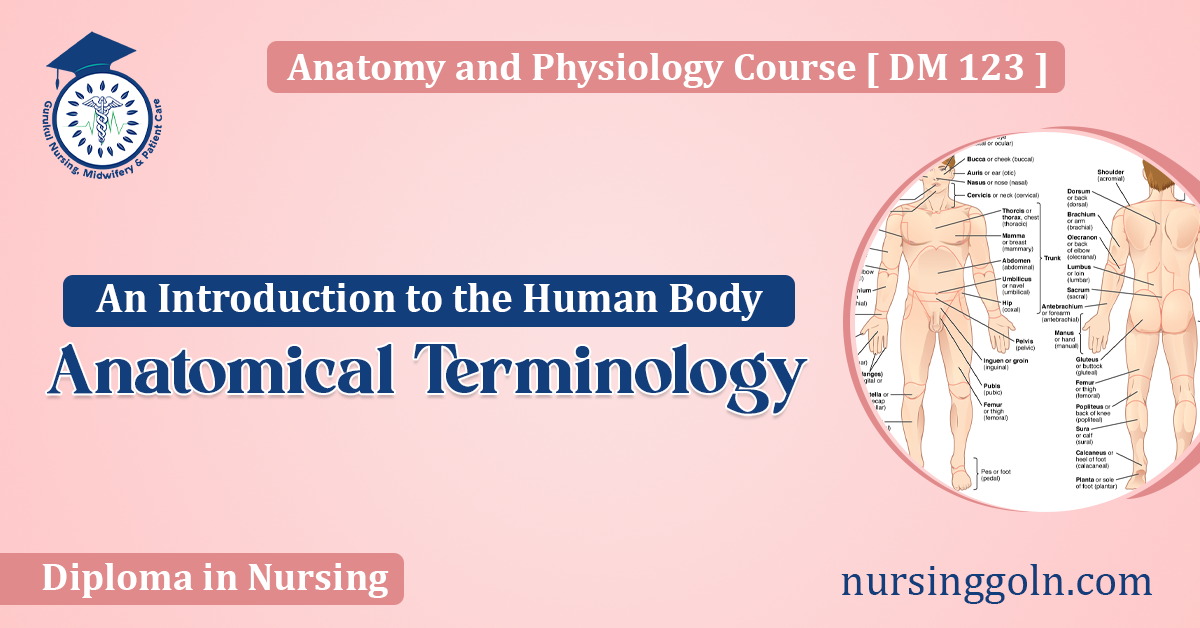
When one delves into the intricate workings of the human body, a language of precision is necessary. This precision is achieved through the use of anatomical terminology—a standardized set of terms that provides consistency and clarity for healthcare professionals, scientists, and students alike. The beauty of these terms is that they describe locations, orientations, and relationships in the body with such accuracy that ambiguity is eliminated. This article introduces the foundational aspects of anatomical terminology, offering readers a gateway to understand the human body’s organization.

I. Anatomical Position and Directional Terms
Anatomical Position: A cornerstone of anatomical terminology is the ‘anatomical position’. It is a standard position that the body is considered to be in, making it easier to describe locations and relations. In this position:
- The body stands erect.
- Feet are parallel and close together.
- Arms are at the sides of the body.
- Palms face forward.
- Thumbs point away from the body.
- The head faces forward.
Directional Terms: These terms describe the relative position of one body part to another, always referring back to the standard anatomical position.
- Anterior (or ventral): Towards the front. E.g., The sternum is anterior to the spine.
- Posterior (or dorsal): Towards the back. E.g., The heel is posterior to the toes.
- Medial: Nearer to the midline. E.g., The nose is medial to the eyes.
- Lateral: Farther from the midline. E.g., The ears are lateral to the eyes.
- Superior (or cranial): Towards the head. E.g., The forehead is superior to the mouth.
- Inferior (or caudal): Away from the head. E.g., The navel is inferior to the chest.
- Proximal: Nearer to the attachment point of a limb. E.g., The elbow is proximal to the wrist.
- Distal: Farther from the attachment point of a limb. E.g., The fingers are distal to the wrist.
- Superficial (or external): Closer to the body surface. E.g., The skin is superficial to the muscles.
- Deep (or internal): Away from the body surface. E.g., The lungs are deep to the ribcage.
II. Body Planes and Sections
To view internal structures, the body can be divided into sections along specific planes:
- Sagittal Plane: Divides the body vertically into right and left parts. If the division results in equal halves, it’s called the median, or midsagittal, plane.
- Frontal (or coronal) Plane: Divides the body vertically into anterior and posterior parts.
- Transverse (or horizontal) Plane: Divides the body horizontally into superior and inferior parts, creating a cross-section.
III. Body Cavities and Membranes
The human body houses several cavities that protect, separate, and support internal organs. Two main cavity categories are the dorsal and ventral body cavities.
Dorsal Body Cavity:
- Cranial Cavity: Encloses the brain.
- Vertebral Cavity (or spinal cavity): Encloses the spinal cord.
Ventral Body Cavity:
- Thoracic Cavity: Contains the heart and lungs. Further subdivided into:
- Pleural Cavities: Each surrounds a lung.
- Mediastinum: Central region that contains the heart in the pericardial cavity, trachea, esophagus, and other structures.
- Abdominopelvic Cavity: Divided into:
- Abdominal Cavity: Contains the liver, stomach, intestines, and other organs.
- Pelvic Cavity: Contains the bladder, reproductive organs, and rectum.
These cavities are lined by serous membranes, which reduce friction between adjacent organs. The two-layered serous membranes have a parietal layer (lining the cavity wall) and a visceral layer (covering the organs).
IV. Regions and Quadrants of the Abdomen
For clinical purposes, the abdomen is divided into either nine regions or four quadrants.
Nine Regions:
- Right Hypochondriac: Upper right region below the ribs.
- Epigastric: Central upper region above the stomach.
- Left Hypochondriac: Upper left region below the ribs.
- Right Lumbar: Middle right side between the bottom of the ribs and the top of the hip.
- Umbilical: Centermost region surrounding the navel.
- Left Lumbar: Middle left side between the bottom of the ribs and the top of the hip.
- Right Iliac (or inguinal): Lower right side.
- Hypogastric (or pubic): Central lower region below the navel.
- Left Iliac (or inguinal): Lower left side.
Four Quadrants:
- Right Upper Quadrant (RUQ)
- Left Upper Quadrant (LUQ)
- Right Lower Quadrant (RLQ)
- Left Lower Quadrant (LLQ)
V. Regional Terms
Regional terms allow for a more detailed description of body areas:
- Cephalic: Head
- Cervical: Neck
- Thoracic: Chest
- Brachial: Arm
- Antebrachial: Forearm
- Pelvic: Pelvis
- Patellar: Front of knee
- Crural: Leg (from knee to ankle)
- Tarsal: Ankle … and many more.
VI. Conclusion
Anatomical terminology provides a universal language that offers precision and clarity. From directional terms to body planes and sections, these terms ensure that medical professionals and students worldwide can communicate effectively about the human body. Grasping these terminologies facilitates a deeper understanding of our body’s structures and functions, paving the way for advancements in medical and scientific endeavors.