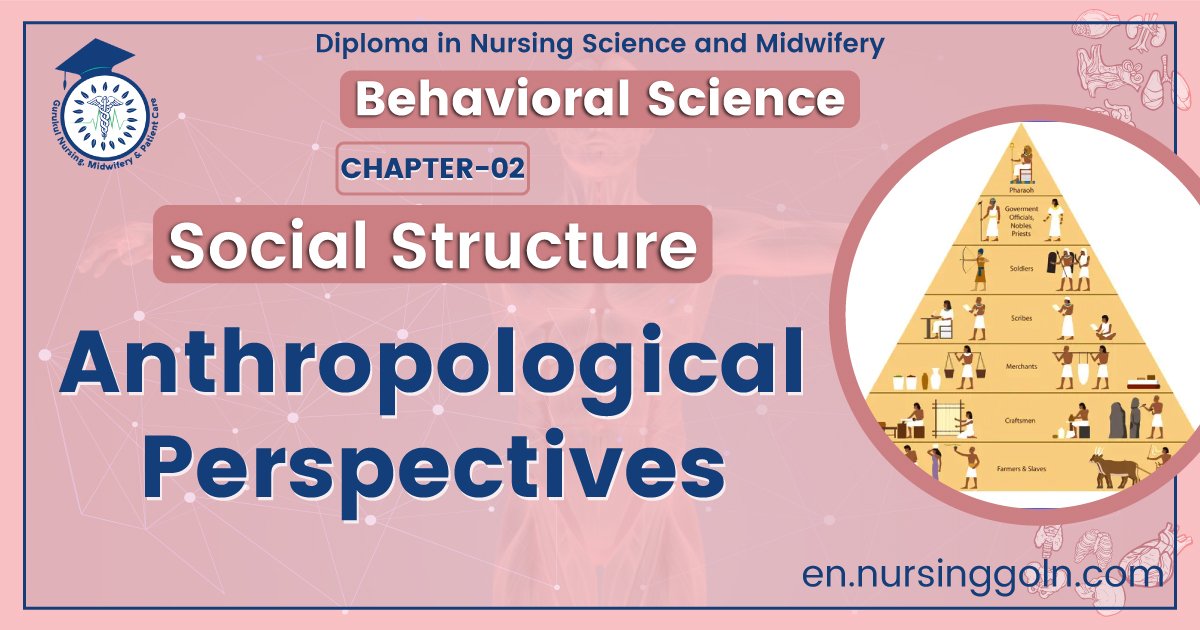
Anthropological Perspectives – Behavioral sciences explore the cognitive processes within organisms and the behavioral interactions between organisms in the natural world. It involves the systematic analysis and investigation of human and animal behavior through the study of the past, controlled and naturalistic observation of the present and disciplined scientific experimentation and modeling.
It attempts to accomplish legitimate, objective conclusions through rigorous formulations and observation. Generally, behavior science deals primarily with human action and often seeks to generalize about human behavior as it relates to society.
Anthropological Perspectives
Social anthropology is the study of patterns of behaviour in human societies and cultures. It is the dominant constituent of anthropology throughout the United Kingdom and much of Europe, where it is distinguished from cultural anthropology. In the United States, social anthropology is commonly subsumed within cultural anthropology or sociocultural anthropology.
Contemporary social anthropology tackles an enormous variety of topics. These range from the social implications of new reproductive and information technologies through the analysis of the social meanings of consumer behaviour, to the study of violence, poverty, and the means for resolving conflicts and alleviating human suffering.
Because of its focus on behaviour, social organization and meaning, anthropology is used in a number of contemporary settings. Companies such as Google and Intel, for example, use anthropologists to understand how people interact with technology.
Anthropological approaches are also increasingly used in the health sector to redesign the patient experience.
Social Class & Social Unit
A social class is a group of people of similar status, rank, or common characteristics (i.e. lifestyle) and commonly sharing similar levels of power and wealth.
This set of people is known on the evidence of their link to the means of production (economic) who have differential access to wealth, power, and some styles of life. Although the two main criteria such as wealth and occupation together were considered to create social classes, other criteria such as education, hereditary prestige, skills, and recognition by others also play an important part in class formation.
Social class is a principal type of social stratification found in all societies. Sometimes the word class is used to represent a group of professors, artists, engineers, doctors, etc., it is also used to refer to things whether good, better, best, and so on.
But the idea of social class is more used in sociology denoting a kind of social stratification than anything. Society is divided into various classes. A class represents people with certain economic features in society.
Karl Marx has divided society economically into the capitalist and proletariat classes. In sociological interpretation, a class should not only be defined as an economic class but also as a social class. The social structure encompasses various classes through which a society is stratified. We can see people considered as black or white as per color, rich or poor as per their economic status, and upper or lower as per their caste. Thus a group of people affiliated with certain characteristics is called class.

Definition of Social Class
According to Lapiere
“A Social Class is a culturally defined group that is accorded particular position or status within the population as a whole.”
According to MacIver and Page
“A Social Class is a portion of community marked off form the rest by social status.”
According to Ogburn and Nimkof
“A Social Class is the aggregate of Persons having essentially the same Social status in a given society.”
Characteristics of Social Class
1. Element of -Social Stratification: Class is a System of Social stratification and almost universal.
2. Hierarchy Just live Class groups: Classes also have a hierarchical order in relation toeach other’s.
3. Open System: Class is an open system, because, a person can change his statues by his efforts.
4. Class is achieved: It is not based on birth like the caste, but is achieved by individual qualities or efforts.
5. Common mode of life: People of the same social class have usually a common mode of life, and this may be differentiated from other classes.
6. Economic differences: Class system is based primarily upon economic differences among social groups.

Classification of Social Class
Social Class may be determined or basis several things as mentioned below:
A. On the basis of mode of earning livelihood:
- Business class,
- Professional
- Labor class.
B. On the basis of economic Conditions:
- Upper Class,
- Middle Class,
- Lower Class.
C. On the basis of educational achievements:
- Uneducated,
- Less educated.
- Highly educated
There is a high degree of social mobility with in the Class system. Class boundaries are not always clean.
D. In western Society generally four Classes can be identified:
a. Upper Class:
- Wealth financiers,
- Employers
- Industrialists,
b. Middle Class: Professionals and holders of non-manual and Jobs.
c. Lower Class: Workers and holders of low-paid Jobs.:
d. Under Class: People who short-term and low status Jobs, the long-term Unemployed.
Difference between Social Caste and Class
Caste
- Castes are perceived as hereditary groups with a fixed ritual status according to Max Weber’s phraseology
- A person belonging to certain caste has to follow certain traditions, rituals and customs
- According to Anthropologist Louis Dumont and Social Anthropologist Edmund Leach, caste is unique to the Indian sub-continent
- The caste system does not promote democracy, since it severely limits equal opportunity to rise from an individual’s station
- Occupational mobility is one of the biggest banes of the Caste system. A person has to continue in the line of work of his ancestors irrespective of his interest, education and skills.
- The Social Gap between people belonging to different castes is very wide which is not healthy for the overall progress of a nation
- Caste System is static
- Caste system works as a political force.
- Cumulative Inequality is a distinctive feature of the caste system
Class
- A person’s Class is based on social status, wealth and power acquired, level of education and other achievements.
- A person belonging to a certain class is not bound by customs, rituals or traditions.
- Classes are usually found in highly industrialized countries located in Europe, North America.
- Class system does not necessarily act as a hindrance to democracy, since classification is based on education, social status, and the work one does.
- Social class does not act as a hindrance to occupational mobility. A person belonging to any class can change his occupation based on his skills, education and interests.
- The Social gap between people belonging to different classes is narrower when compared to the gap that is prevalent among people belonging to different Castes.
- The class system is dynamic
- Class system does not act as a political force.
- Dispersed Inequality is a distinctive feature of the class system
Definition of Social Unit:
An individual, or a group or community, considered as a discrete constituent of a society or larger group.
Or
Social unit may be defined as an organization regarded as part of a larger social group.
Levels of Social Unit:
Although levels of analysis are not necessarily mutually exclusive, the three general levels into which research may fall are the
1. Micro-level,
2. The Meso-level, and
3. The Macro-level.
Micro-level: The smallest unit of analysis in the social sciences is an individual in their social setting. At the micro-level, also referred to as the local level, the research population typically is an individual in their social setting or a small group of individuals in a particular social context. Examples of micro-level levels of analysis include, but are not limited to, the following.
- Person.
- Citizen.
- Partnership, marriage.
- Household.
- Neighborhood
Meso-level: In general, a meso-level analysis indicates a population size that falls between the micro- and macro-levels, such as a community or an organization. However, meso-level may also refer to analyses that are specifically designed to reveal connections between micro- and macro-levels. Sometimes referred to as mid-range, especially in sociology. Examples of meso- level units of analysis include, but are not limited to, the following.
- Clan.
- Tribe
- Community.
- Village, town, city.
- Formal organization.
- State.
- Civilization.
Macro level: Macro-level analyses generally trace the outcomes of interactions, such as economic or other resource transfer interactions over a large population. Also referred to as the global level. Examples of macro-level units of analysis include, but are not limited to, the following.
- Nation.
- Society.
- International.
- Global