
BED MAKING – Nursing is a profession within the healthcare sector focused on the care of individuals, families, and communities so they may attain, maintain, or recover optimal health and quality of life. Nurses may be differentiated from other healthcare providers by their approach to patient care, training, and scope of practice. Nurses practice in many specialisms with differing levels of prescriber authority.
Many nurses provide care within the ordering scope of physicians, and this traditional role has shaped the public image of nurses as care providers. However, nurses are permitted by most jurisdictions to practice independently in a variety of settings depending on training level. In the postwar period, nurse education has undergone a process of diversification towards advanced and specialized credentials, and many of the traditional regulations and provider roles are changing.
Nurses develop a plan of care, working collaboratively with physicians, therapists, the patient, the patient’s family, and other team members, that focus on treating illness to improve quality of life. Nurses may help coordinate the patient care performed by other members of an interdisciplinary healthcare team such as therapists, medical practitioners, and dietitians. Nurses provide care both interdependently, for example, with physicians, and independently as nursing professionals.
BED MAKING
Definition of Bed Making:
Bed making is a technique which provides enough area to the patient on which he/she can be comfortable and perform his activities of daily living and also to facilitate therapeutic care.
or
Bed making may be defined as preparing a bed that is comfortable and suitable for a hospitalized patient.
Purposes of a Closed/Unoccupied Bed:
1. To provide, rest, comfort and safety to the patient.
2. To maintain a clean environment and neat appearance to the unit.
3. To reduce transmission of microorganisms.
4. To economize time, material and effort.
5. To promote cleanliness.
6. To observe patient and to prevent complications.
7. To provide smooth, wrinkle free bed thus minimizing sources of skin irritation.
Purposes of an Open/ Occupied Bed:
1. To provide comfort for patients whose physical condition confines them to bed and for patients on imposed bed rest for therapeutic reasons
2. To help him have a good relaxed sleep.
3. To give active and passive exercises to the patient and promote cleanliness.
4. To change wet/soiled linen for the bed-ridden patients.
5. To prevent bed sore.
6. To maintain neat appearance and clean environment.
7. To establish a good nurse patient relationship.
Types of Bed
There are two main types of bed:
A. Simple bed:
a) Closce bed or unoccupied bed- The bed is ready for a new patient & a bed made without the patient in the bed.
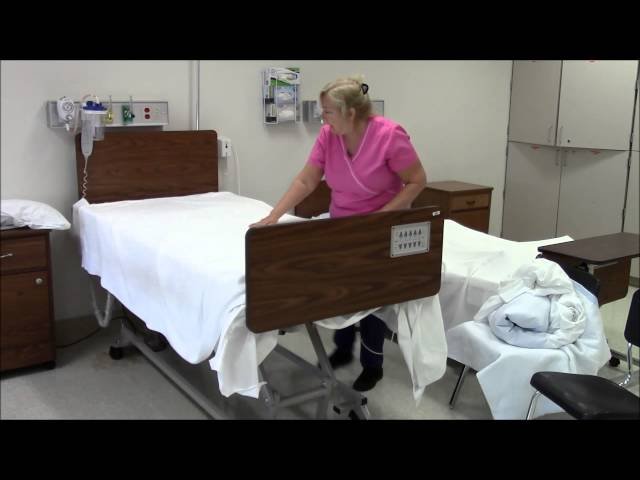
Figure: Closed bed or unoccupied bed

Figure: Open or occupied bed
B. Special bed:
a) Fowlers bed
b) Operation bed or Surgical bed
c) Cardiac bed
d) Fracture bed or Amputation bed
e) Divided bed
f) Rheumatic bed
g) Renal bed
General/Basic Principles of Bed Making:
1. When removing sheets from the bed lift the mattress while loosening the bed linen. Never full sheets with force
2. Always foid ved linen from top to bottom.
3. Always arrange bed linen in correct order with closed side away from you before making the.
bed. It should not touch to the floor.
4. See there is no draught.
5. Dirty and clean linen should be kept separate.
6. Dirty linen should be kept in dirty box.
7. Uniform should never touch the bed.
8. While tacking bedding under the mattress the palm of the hand should face down in order to protect our nails.
9. Keep the open end of the pillow away from the entrance of the ward.
10. Soiled linen should not be thrown on the floor, but it should be kept in dirty linen box.
11. Soiled woolen blankets are to be kept separately and not with the bed linen.
12. When making an occupied bed try not to cause discomfort by shaking the bed or moving the patient unnecessarily
Procedure of Making Unoccupied Bed:
Equipment:
1. Two large sheet
2. Drawsheet
3. Blankets
4. Bedspread
5. Pilow cases
6. Waterproof sheet or rubber makintosh
7. Linen hamper
8. Bedside table or chair
9. Disposable gloves (optional)
Procedure:
1. Wash hand
2. Wear disposable gloves
3. Assemble and arrange equipment on a bedside table.
4. Adjust the bed height to a comfortable working position and lower the side rail.
5. Loosen all linen from head to foot on the side near to you. Move to the other side of bed, lower rail and loosen all linen.
6. Fold and keep reversible linens such as blanket or bedspread on bedside table
7. Bundle all soiled linen in bottom sheet and directly place into the laundry bog.
8. Bring mattress towards the head of bed.
9. Place the bottom sheet with its center fold in the center of bed and towards the top to have sufficient sheet to tuck under the head of the mattress.
10. Unfold the bottom sheet, spread it over the matress and tuck in severally with mitered corner.
11. Spread the makintosh at the center of the bed and tuck it along the side.
12. Place the draw sheet over the mackintosh and tuck it along the side.
13. Move to oppositeside and tuck the sheets in the same manner pull the sheets tightly while tucking excess linen under matress.
14. Return to the side of the bed first made. Place the top sheet with its centerfold in the center of the bed. Unfold it the top edge even with the top of the matress. Spread excess sheet over the bottom edge of the matress.
15. Place the blanket over the top sheet about 6 inches below the top of the sheet.
16. If the bed spread is used place it over the blanket
17. Tuck the top sheet, blanket the bed spread under the foot of the bed on the side close to you and miter the corners.
18. Fold the upper 6 inches of the top sheet down over the spread and make a cuff.
19. Move to the otherside of the bed and follow the same procedure for screening top sheets.
20. Put the pillow case and place the pillow at the head end with the open end away from the entrance.
21. Fanfold or pie fold top linens.
22. Rearrange furniture and place personal items within easy reach.
23. Adjust the bed to a comfortable height for the client.
24. Dispose off soiled linen and wash hands.

Procedure of Making An Occupied Bed:
Equioment:
1. Linen hamper
2. Top sheet, draw sheet, bottom sheet.
3. Blanket
4. Bath blanket
5. Gloves
Procedure:
1. Explain the procedure to the client and identify the clients physical ability.
2. Wash hands and put on gloves.
3. Assemble exuipment and arrange on the beds de chair in proper order and remove unnecessary equipment.
4. Close door or draw bedside curtain
5. Adjust the beds height to a comfortable working position.
6. Place the bed in a flat position if the client can tolerate it.
7. Lower the side rail on one side of bed.
8. Loosen all top linen and remove bedspread and blanket separately.
9. Fold and place on the bed side table if bed spread and blanket to be reused.
10. With assistance shift matress up to the head of bed.
11. Assist the client to turn toward the opposite side and reposition the pilow under the clients head.
12. Loosen all bottom linens and fanfold soiled linens as far from the client as possible.
13. Place the clean bottom sheet length wise making sure that middle fold is in the middle of the bed and vertically fanfold the half towards the center of the bed.
14. Tuck the head and, mitre concern and tuck sides
15. Bring the rubber mackintosh back into place and tuck if tightly under the matress.
16. Plan the clean drawsheet on the mackintosh with center fold at the center of bed.
17. Raise side rail on working side and go to the other side
18. Lower side rail. Assist the client to roll slowly. On the other wise oveer folds of linen. Repossition the poilow and top sheet 19. Loosen and remove all bottom linen. Place them in a linen bag on a hamper.
20. Spread clean, fanfold linen smoothly over the age of the matress and tuck it from head to foot.
21. Place a clean topsheet over the client with center fold length wise down middle of the bed unfold over client and ask the client to hold clean topsheet or tuck the sheet around the client shoulder. Remove the solide top sheet and discord in a linen bog. Place blanket over the top sheet and unfold to cover the client making sure that the top edge should be parallel to the edge of top sheet and 6-8 inches from the edge of top sheet.
22. Place and unfold bed spread over blanket extending top edge of spread about to inche above blanket edge.
23. Turn the edge of top sheet down over the top edge of blnket and spread.
24. Raise side rail lower the bed hieght to a comfortable position. Reattach call bell and drainage tubes if any.
25. Change pillow cases annd place them in a position. Replace the comfort in place.
26. Dispose of solide linens according to the hospital policy and wash hands.
Points To Be Remembered During Bed Making:
1. Assess the patient’s pulse, respiration and blood pressure before ambulating.
2. Any comfort device used by the patient should be replaced.
3. The patient should be assisted back to bed.
4. The whole unit of the patient must be made neatrad tidy.
5. Used dusters must be disinfected, washed and dried.
6. If linen is soiled with feces, urine or any uner body fluids, segregate such linen for laundry as per the hospital policy.
Bed Positions Commonly Used by Nurse:
A. Fowler’s position: In this position the bed is raised to angle of 45° or more; semisitting position. It is used during naso-trachial suctioning. It helps promotion of lung expansion. It is preferred while client sits.
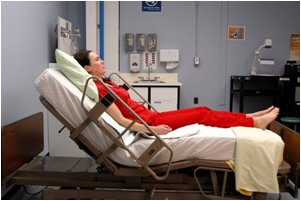
Figure: Fowler’s position
B. Semi-Fowler’s position: Head of the bed is raised approximately 30 inclination less than Fowler’s position. It also promotes lungs expansion helps breathing.
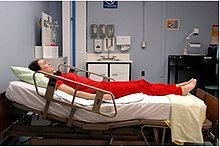
C. Trendelenburg position: Entire bedframe tilted with head of the bed down. It is used for postural drainage. This position also facilitates venous return in clients with poor peripheral perfusion.
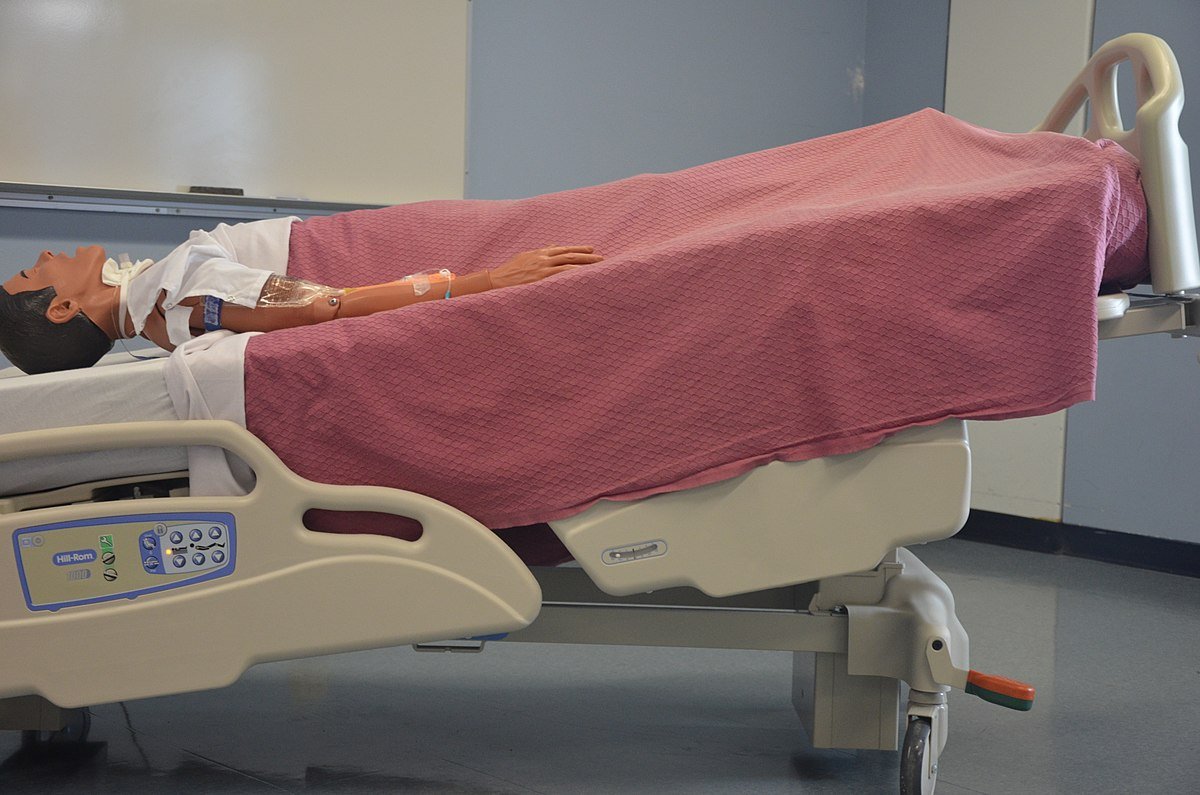
D. Reverse Trendelenburg position: Entire bedframe tilted with foot and bed down, it is used infrequently helps to promote gastric emptying and prevents esophageal reflux.
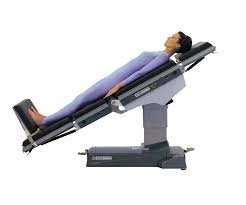
Figure: Reverse Trendelenburg position
E. Flat position: In this position entire bedframe tilted horizontally parallel with floor. It is used for clients with vertebral injuries and in cervical traction and also used for clients who are hypotensive. It is generally preferred by clients for sleeping.

Figure: Flat Position