Blood sugar – Introduction to fundamental concepts of Biological Science including the organization and common characteristics of living matters, cell structures and functions, food production by photosynthesis, harvesting energy, mechanism of cells reproduction, genetics, evolutions, and Human Biology. Introduction to general chemistry including basic concepts about matter, atomic structure, chemical bonds, gases, liquid, and solids, solutions, chemical reactions, acid, bases, and salt;
organic and biochemistry including hydrocarbons and their derivatives, carbohydrates, lipids, proteins, enzymes, vitamins, and minerals, nucleic acids; principles of physics and applications to nursing including gravity and mechanics, pressure, heat and electricity; nuclear chemistry and nuclear physics, effects of radiation on human beings, and protection and disposal. The aim of the course is to acquire knowledge and skills in general biological science, general chemistry and physics.
Blood sugar
Blood Glucose & Diabetes Mellitus
Blood glucose levels:
Normal:
➤ Fasting : 3.6-6.1 mmol/L (65-110 mg/dl).
➤ Random & 2 hrs after breakfast : <7.8 mmol/L (< 140 mg/dl).
Impaired glucose tolerance:
➤ Fasting : 6.1-7 mmol/L (110-126 mg/dl).
➤ Random & 2 hrs after breakfast: 7.8-11 mmol/L (140-199 mg/dl).
Diabetes mellitus:
➤ Fasting : ≥ 7.0 mmol/L (≥ 126 mg/dl).
➤ Random & 2 hrs after breakfast : ≥ 11.1 mmol/L (≥ 200 mg/dl).
[Ref: Davidson’s Medicine 22nd/809]
Oral glucose tolerance test/OGTT
Oral glucose tolerance test (OGTT/GTT):
It is a laboratory test to diagnose DM. When the random blood sugar (RBS) is elevated but not diagnostic of DM, then OGTT is done to assess the glycemic response to oral ingestion of glucose load.
It measures the ability of the body to tolerate or cope with standard dose of glucose. Glucose tolerance is reduced when insulin is insufficient or absent.
Principle:
An oral dose of glucose load is given and the response is noted and compared with the normal pattern.
Indication of OGTT:
➤ Fasting blood glucose: 6.1-6.9 mmol/L.
➤ Random blood glucose: 7.0-11.0 mmol/L.
Pre-requisite for the OGTT:
➤ Unrestricted carbohydrate diet for 3 days before test.
➤ Fasted overnight.
➤ Rest before test (30 minutes), no smoking.
➤ To be seated during whole length of the test.
Procedure:
➤ Collect fasting venous blood for plasma, and urine samples
➤ Give 75 gm glucose in 250-300 ml water by mouth.
➤ Collect venous blood and urine sample, either:
- At the end of 2 hours or
- At half hourly intervals for 2-2.5 hours.
➤ Estimate plasma glucose on each blood sample and examine urine sample for sugar.
Result:
The normal renal threshold for glucose is usually 180 mg/dl (10 mmol/L). In severe cases of diabetes mellitus the fasting value may be more than 180 mg/dl and the peak value may be more than 300 mg/dl.
| Normal (mg/dl) | Diabetes mellitus (mg/dl) | |
| Fasting | 65-110 (3.6-6.1 mmol/L) | ≥ 126 (> 7 mmol/L) |
| 2 hour after 75 gm glucose | <140 (<7.8 mmol/L) | ≥200 (≥ 11.1mmol/L) |
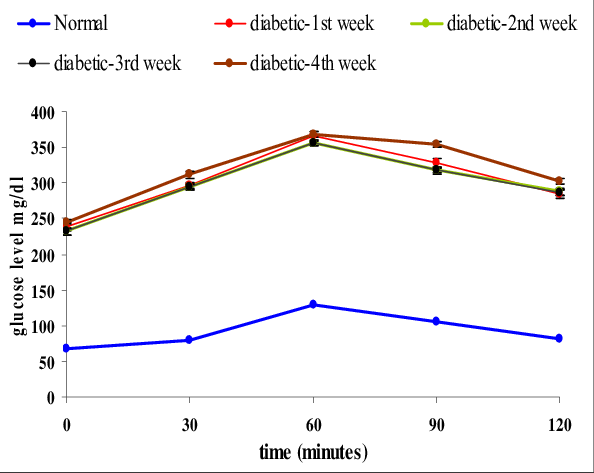
Fig: Glucose tolerance curve (normal & diabetic person)
Glucose Tolerance Test is usually done to-
1. Establish to diagnosis in a suspected case of diabetes mellitus.
2. It is also used in the diagnosis of –
- Renal glycosuria.
- Alimentary glycosuria.
- Endocrine dysfunction.
3. In an established case of diabetes to access the effectiveness of treatment.
4. To assess the ẞ cell reserve or response of ẞ cells of the pancreas.