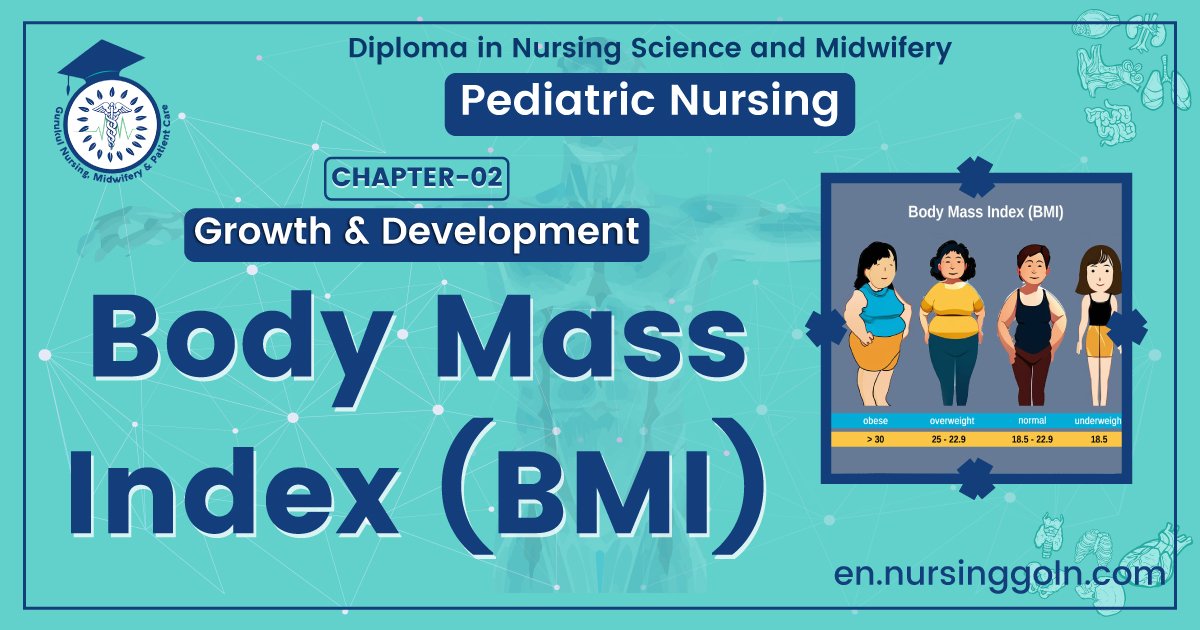
Body Mass Index (BMI) – Health of the children has been considered as the vital importance to all societies because children are the basic resource for the future of humankind. Nursing care of children is concerned for both the health of the children and for the illnesses that affect their growth and development. The increasing complexity of medical and nursing science has created a need for special area of child care, i.e. pediatric nursing.
Pediatric nursing is the specialized area of nursing practice concerning the care of children during wellness and illness. It includes preventive, promotive, curative and rehabilitative care of children. It emphasizes on all round development of body, mind and spirit of the growing individual. Thus, pediatric nursing involves in giving assistance, care and support to the growing and developing children to achieve their individual potential for functioning with fullest capacity.
Body Mass Index (BMI)

The body mass index (BMI), or Quetelet index, is a measure for human body shape based on an individual’s mass and height.
Measure Body Mass Index (BMI):
The body mass index (BMI) or Quetelet index is a value derived from the mass (weight) and height of an individual. The BMI is defined as the body mass divided by the square of the body height, and is universally expressed in units of kg/m², resulting from mass in kilograms and height in meters.
Formula:
| Metric BMI Formula | Imperial BMI Formula |
|
|
Example Using Formula
For an adult with height of 180 cm and weight of 75 kg. Our first step needs to be to convert the height into meters (British spelling: metres). As there are 100cm in a meter, we divide our figure by 100. This gives us 1.8m.

Let’s plug those figures into our formula:
BMI =75(1.8×1.8)
BMI =753,24
This gives us a BMI figure of 23.15.
BMI Chart:
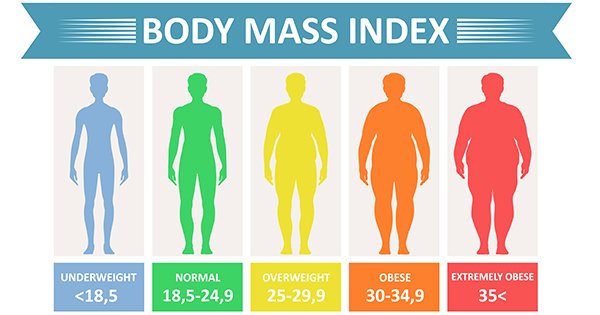
| Category | BMI range – kg/m² |
| Very severely underweight | Less than 15 |
| Severely underweight | 15.0-16.0 |
| Underweight | 16.0-18.5 |
| Normal (healthy weight) | 18.5-25 |
| Overweight | 25-30 |
| Obese class I (Moderately obese) | 30-35 |
| Obese class II (Severely obese) | 35-40 |
| Obese class III (very severely obese) | Over 40 |
Risks Associated with Being Overweight
Being overweight increases the risk of a number of serious diseases and health conditions. Below is a list of said risks, according to the Centers for Disease Control and Prevention (CDC):
- High blood pressure
- Higher levels of LDL cholesterol, which is widely considered “bad cholesterol,” lower levels of HDL cholesterol, considered to be good cholesterol in moderation, and high levels of triglycerides
- Type II diabetes
- Coronary heart disease
- Stroke
- Gallbladder disease
- Osteoarthritis, a type of joint disease caused by breakdown of joint cartilage
- Sleep apnea and breathing problems
- Certain cancers (endometrial, breast, colon, kidney, gallbladder, liver)
- Low quality of life
- Mental illnesses such as clinical depression, anxiety, and others
- Body pains and difficulty with certain physical functions
- Generally, an increased risk of mortality compared to those with a healthy BMI
Risks Associated with Being Underweight
- Being underweight has its own associated risks, listed below:
- Malnutrition, vitamin deficiencies, anemia (lowered ability to carry blood vessels)
- Osteoporosis, a disease that causes bone weakness, increasing the risk of breaking a bone
- A decrease in immune function
- Growth and development issues, particularly in children and teenagers
- Possible reproductive issues for women due to hormonal imbalances that can disrupt the menstrual cycle. Underweight women
- also have a higher chance of miscarriage in the first trimester
- Potential complications as a result of surgery
- Generally, an increased risk of mortality compared to those with a healthy BMI

Importance of Learning Growth and Development;
The study of growth and development is essential to the nurse to provide appropriate care to the children. It helps the nurses in the following aspects:
- To learn what to expect from a particular child at a particular age.
- To assess the normal growth and development of children.
- To detect deviations from normal growth and development, i.e. physical and psychological abnormalities and to understand the
- reasons of particular conditions and illnesses.
- To ascertain the needs of the child according to the level of growth and development.
- To plan and provide holistic nursing management to the child, based on developmental stages.
- To teach and guide the parents and caregivers to anticipate the problems and to render tender loving care to their children.
- To develop a rapport with the child to enhance the provision of health care and to help to build healthy lifestyle for optimum health for the future.
(Ref by: Paediatric Nursing, Parul Datta/3rd/113