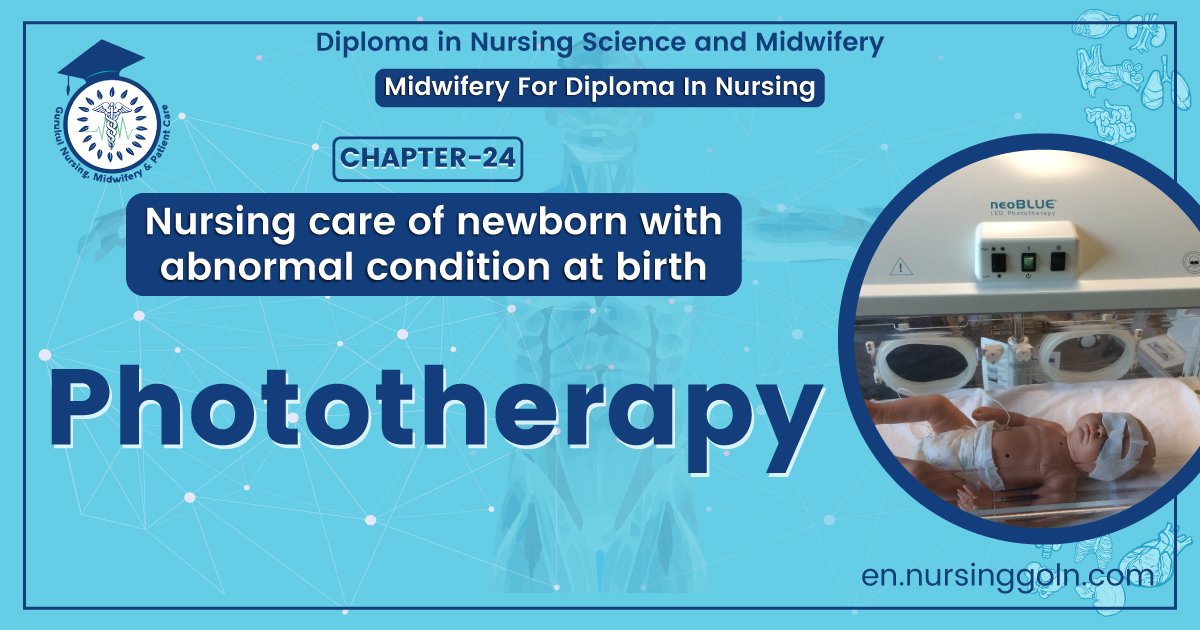
Classification of Phototherapy – This course is designed to understand the care of pregnant women and newborn: antenatal, intra-natal and postnatal; breast feeding, family planning, newborn care and ethical issues, The aim of the course is to acquire knowledge and develop competencies regarding midwifery, complicated labour and newborn care including family planning.
Classification of Phototherapy
Phototherapy
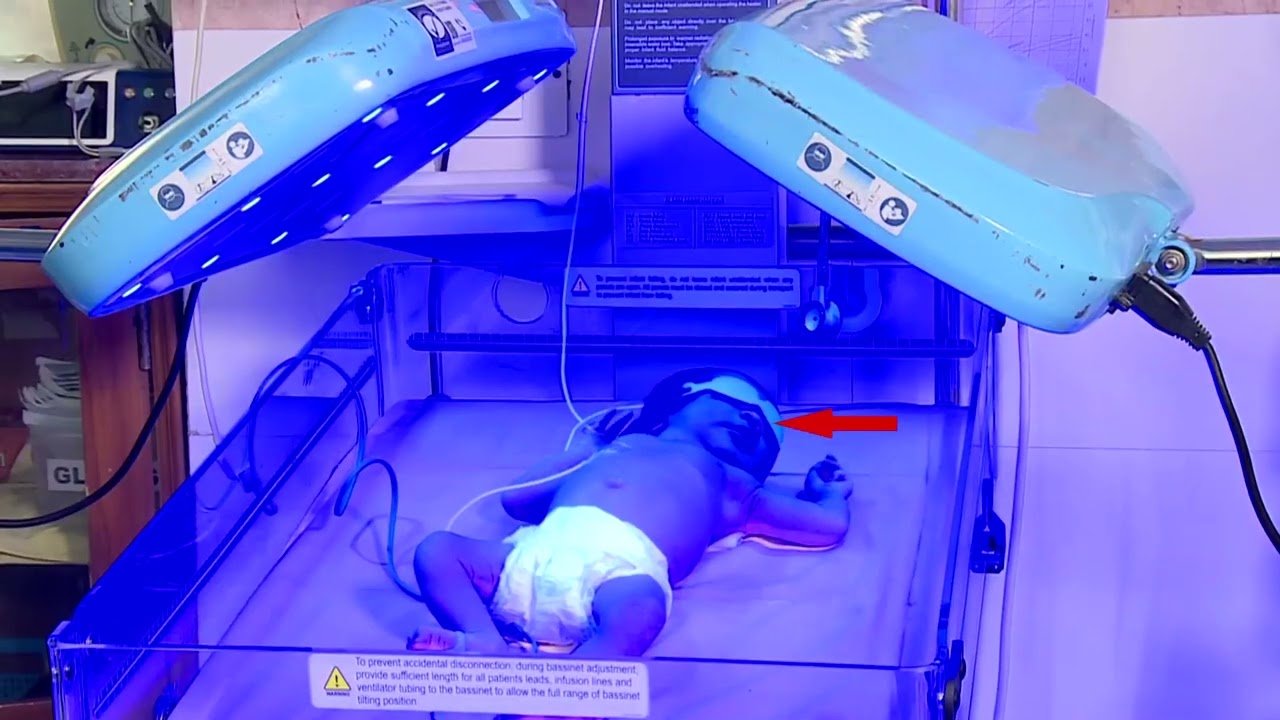
Phototherapy is the procedure for reducing the jaundice in neonates by causing photo-oxidation and photo-isomerization of the unconjugated bilirubin using light source of 450-460 nm wavelength.
Note: The baby is kept naked under these lights till the serum bilirubin comes down to safe levels. The bilirubin levels may be monitored every 6 to 12 hours.
Or
A treatment for hyperbilirubinemia and jaundice in the newborn that involves the exposure of an infant’s bare skin tointense fluorescent light. The blue range of light accelerates the excretion of b ilirubin in the skin, decomposing it byphotooxidation.
Or
Phototherapy: Treatment with light. For example, a newborn with jaundice may be put under special lights to help reduce the amount of bilirubin pigment in the skin.
| Birth weight | Serum bilirubin at which phototherapy is indicated |
| 2500g | 15 mg/dl |
| 2000-2500g | 12 mg/dl |
| 15000-2000g | 10 mg/dl |
| 1000-1500g | 7 mg/dl |
| <1000g | 5 mg/dl |
Mechanism of action
Phototherapy or exposure to light is known to cause photoisomerization of bilirubin to more polar, water soluble, harmless compounds which are hardly excrete in the bile, feces and urine.
Procedure of phototherapy
1. The naked infant is exposed under phototherapy unit which is kept at a distane of about 45
cm from the baby skin.
2. During exposure to light, the eyes must be effectively shielded to prevent retinal damage.
3. The position of the infant should be changed frequently so that maximum skin is exposed to light. The infant is kept under the light round the clock and taken out only for feeding or change of wet napkins.
4. Most preterm babies are placed under phototherapy when their bilirubin approaches to 10 to 12 mg/dl, and term babies phototherapy when their serum bilirubin approaches to 15 mg/dl.
Side effects of phototherapy
a. Immediate:
- Passage of loose green stools, because, of transient lactose intolerance and irritant of photocatabolites on intestinal mucosa.
- Dehydration (mild) due to increased insensible water loss.
- Hyperthermia and irritability
- Skin rashes, usually mild and self-limiting.
- Bronze baby syndrome.
- Retinal damage eye injury from bandages is uncommon.
b. Late:
- Damage to intracellular DNA.
- Disturbances in future sex behavior.
C. Nursing Staff:
- Headache and giddiness
Management of neonate baby of phototherapy
1. To maximize the effectiveness of phototherapy the neonate should be completely undressed or wearing only a diaper then infant is exposed under phototherapy until which is kept at a distance of about 45 cm from the baby’s skin.
2. During exposure to light, the eyes must be effectively shielded to prevent retinal damage.
3. The position of the infant should be changed frequently so that maximum skin is exposed to light. The infant is kept under the light round-the-clock and taken out only for feeding or change of weight napkins.
4. Most partum babies are placed under phototherapy when their serum bilirubin approaches to 10 L2 mg/dl, term babies are given phototherapy when their serum bilirubin approaches to 15 mg/dl.
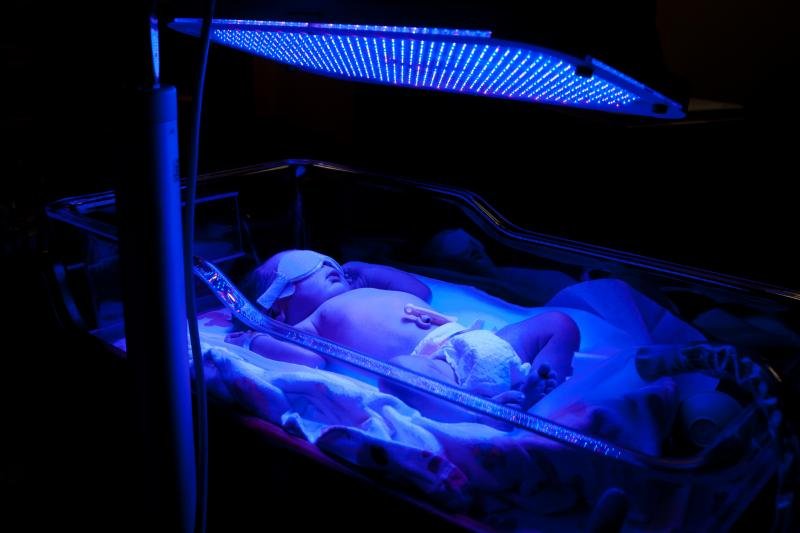
5. During phototherapy the infant should be closely watched for hydration status, temperature, degree of jaundice and anaemia. Phototherapy is by and large safe but may produce loose greenish stool, dehydration, hypothermia, hyperthermia, and skin rash. During phototherapy, the clinical evaluation of the severity of jaundice becomes unreliable because the infants skin gets bleached under light.
6. 24 48 hour exposure is generally long enough to bring down serum bilirubin level to safe limit.