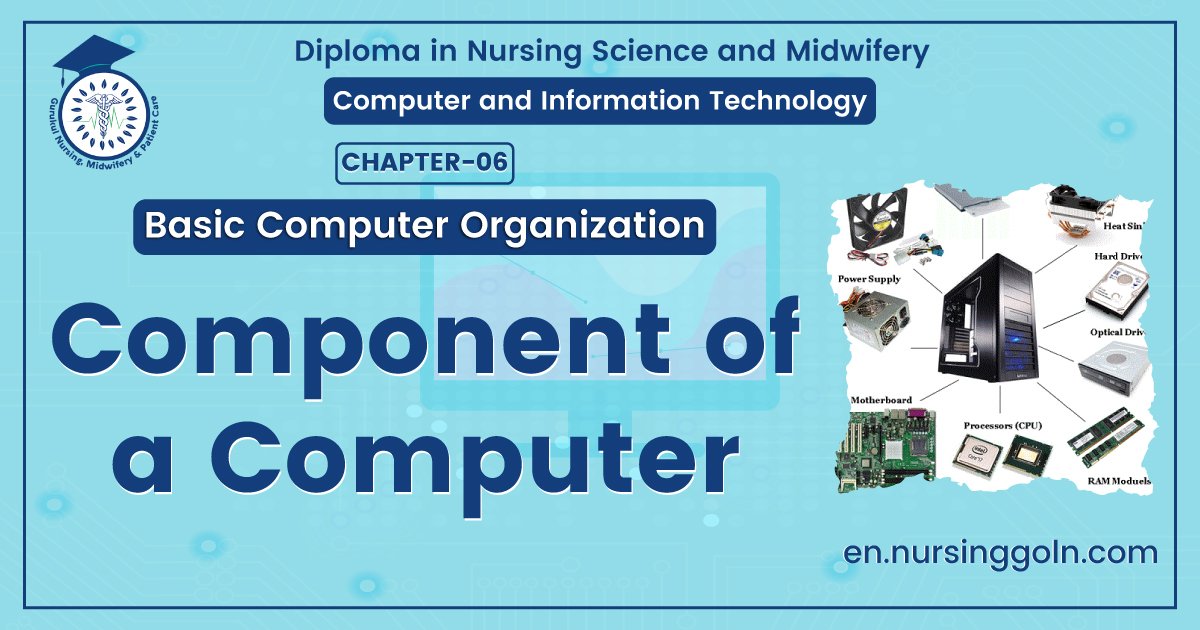
Component of a Computer – This book covers the entire syllabus of “Computer & Information Technology” prescribed by the BNMC for B.Sc. in Nursing Science & Diploma in Nursing Science & Midwifery students. We tried to accommodate the latest information and topics.
This book is an examination setup according to the teachers’ lectures and examination questions. We hope in touch with the book students’ knowledge will be upgraded and flourished. The unique way of presentation may make your reading of the book a pleasurable experience.
Component of a Computer:
A. Input unit:
- Data and instructions must enter a computer system before the computer can perform any computation on the supplied data.
- The input unit that links a computer with its external environment performs this task.
- Data and instructions enter a computer through an input unit in a form that depends upon the input device used.
- In short, an input unit performs following functions:
✓ It accepts (or reads) instructions and data from outside world.
✓ It converts these instructions and data in computer acceptable form. Units called input interfaces accomplish this task.
✓ It supplies the converted instructions and data to the storage unit for storage and further processing.
B. Output unit
- An output unit performs the reverse operation of that of an input unit.
- It supplies information obtained from data processing to outside world.
- Hence, it links a computer with its external environment. As computers work with binary code, results produced are also in binary form.
- In short, an output unit performs following functions:
✓ It accepts the produced results, which are in coded form. We cannot understand the coded results easily.
✓ It converts these coded results to human acceptable (readable) form. Units called output interfaces accomplish this task.
✓ It supplies the converted results to outside world.

C. Storage unit
- Data and instructions entered into a computer system through input units have to be stored inside the computer before actual processing starts.
- Similarly, results produced by a computer after processing have to be kept somewhere inside the computer system before being passed on to an output unit.
- Moreover, a computer must also preserve intermediate results for ongoing processing.
- Storage unit of a computer system caters to all these needs.
- It provides space for storing data and instructions, intermediate results, and results for output.
- In short, a storage unit holds (stores):
✓ The data and instructions required for processing (received from input units).
✓ Intermediate results of processing.
✓ Final results of processing, before the system releases them to an output unit. - Storage unit of all computers is comprised of following two types of storage:
✓ Primary storage. Primary storage of a computer system, also known as main memory
✓ Secondary storage. Secondary storage of a computer system, also known as auxiliary storage.
D. Central processing unit (CPU):
- Control unit (CU) and arithmetic logic unit (ALU) of a computer system are together known as the central processing unit (CPU).
- It is the brain of a computer system.
- In a human body, the brain takes all major decisions and other parts of the body function as directed by the brain. Similarly, in a computer system, the CPU performs all major calculations and comparisons, and also activates and controls the operations of other units of the computer system.
a) Arithmetic logic unit (ALU):
- A computer performs all calculation and comparison (decision-making) operations in the ALU.
- During processing of a job, the computer transfers data and instructions stored in its primary storage to ALU as and when needed.
- ALU does the processing and the computer temporarily transfers the intermediate results generated there back to primary storage until needed later.
b) Control unit (CU):
- A computer’s control unit does not perform any actual processing of jobs, but acts as the central nervous system for other components of the computer system.
- It manages and coordinates the operations of all other components.
- It obtains instructions from a program stored in main memory, interprets the instructions, and issues signals causing other units of the system to execute them.
Difference between ALU and CPU:
| Arithmetic logic unit (ALU): | Central processing unit (CPU): |
| ALU is a component of CPU which performs all the arithmetic and logical operations. | The CPU is the control center for a computer, which guides, directs and governs its performance |
| ALU stands for Arithmetic logic unit | CPU Stands for Central processing unit |
| ALU is the part of CPU | CPU is the heart/brain of Computer |
| It is a subsection of CPU | CPU is the master driver of a computer |
| It handle mathematical and logic comparisons | CPU performs all major calculation and comparisons |
Difference between ALU and CU:
| Traits | ALU | CU |
| A. Definition | ALU (Arithmetic Logical Unit) is a circuit component of CPU that deals with the mathematical calculations. | CU (Control Unit) is one of the two main components of the CPU. It deals with the coordination between the hardware devices attached with each either. |
| B. Functions | ALU deals with all the mathematical and logical operations. | CU deals with the direction of all the tasks and operations performed by CPU. |
| C. Impact on Each -other | ALU deals with the manipulation of the data and works according to the instructions provided by CU. | CU provides the instructions to ALU and coordinates according to the nature of data provided and nature of work to be performed. |
