Concept about Postural Drainage – Introduction to fundamental concepts of Biological Science including the organization and common characteristics of living matters, cell structures and functions, food production by photosynthesis, harvesting energy, mechanism of cells reproduction, genetics, evolutions, and Human Biology. Introduction to general chemistry including basic concepts about matter, atomic structure, chemical bonds, gases, liquid, and solids, solutions, chemical reactions, acid, bases, and salt;
organic and biochemistry including hydrocarbons and their derivatives, carbohydrates, lipids, proteins, enzymes, vitamins, and minerals, nucleic acids; principles of physics and applications to nursing including gravity and mechanics, pressure, heat and electricity; nuclear chemistry and nuclear physics, effects of radiation on human beings, and protection and disposal. The aim of the course is to acquire knowledge and skills in general biological science, general chemistry and physics.
Concept about Postural Drainage
Postural drainage is one way to help treat breathing problems due to swelling and too much mucus in the airways of the lungs.
or
Postural drainage (PD) is drainage used in bronchiectasis and lung abscess. The patient’s body is positioned so that the trachea is inclined downward and below the affected chest area.
or
Postural drainage (bronchial drainage) is a means of mobilizing secretions in one or more lung segments to the central airways by placing the patient in various positions so that gravity assists in the drainage process.
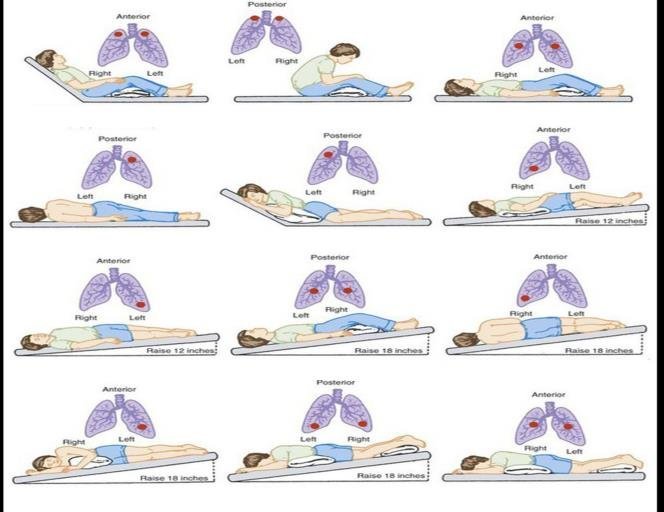
Purposes/ Uses of Postural Drainage:
1. Prevent accumulation of secretions in patients at risk for pulmonary complications. This may include:
- Patients with pulmonary diseases that are associated with increased production or viscosity of mucus, such as chronic bronchitis and cystic fibrosis.
- Patients who are on prolonged bed rest.
- Post surgical patients who have received general anesthesia and who may have painful incisions that restrict deep breathing and coughing postoperatively.
- Any patient who is on a ventilator if they are stable enough to tolerate the treatment.
2. Remove secretions already accumulated in the lungs of:
- Patients with acute or chronic lung disease, such as spneumonia, Atelectasis, acute lung infections, and COPD.
- Patients who are generally very weak or are elderly.
- Patients with artificial airways.