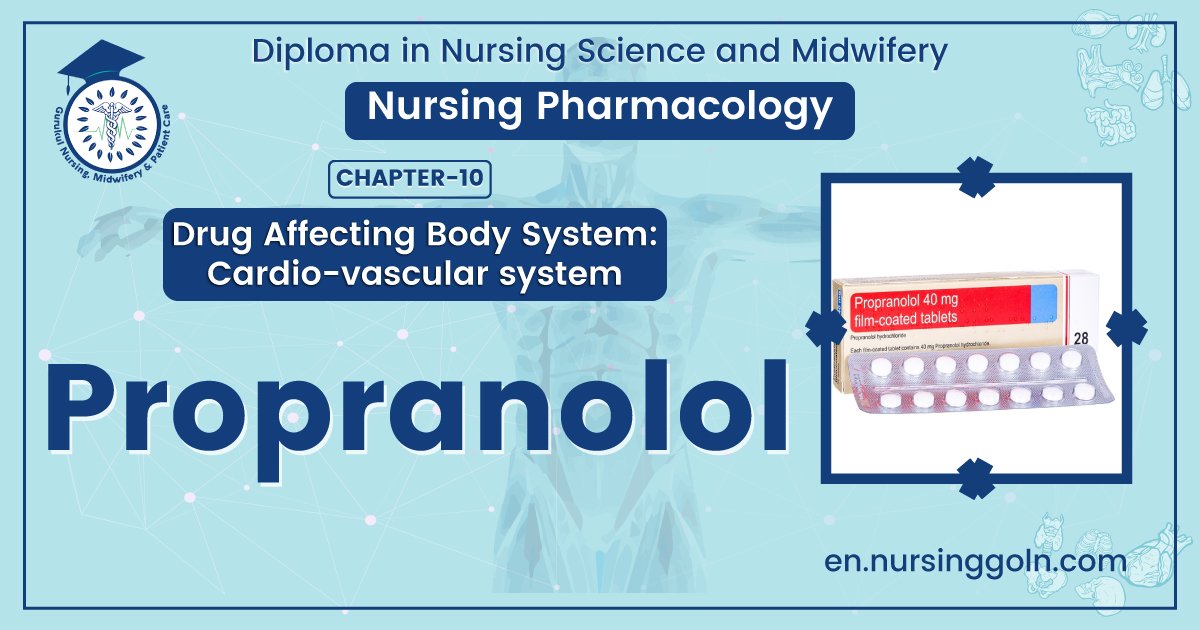
Concept About Propranolol – This book covers the entire syllabus of “Pharmacology” prescribed by BNMC- for diploma in nursing science & midwifery students. We tried to accommodate the latest information and topics. This book is an examination setup according to the teachers’ lectures and examination questions.
At the end of the book, previous questions are given. We hope in touch with the book students’ knowledge will be upgraded and flourish. The unique way of presentation may make your reading of the book a pleasurable experience.
Concept About Propranolol
Anti-hypertensive effects of propranolol
Propranolol has historically been the most widely used ẞ-blocker in hypertension.
Mechanism of action: reversible competitive antagonism at B-receptors (both B1 and B2).
Routes of administration: oral, sublingual, intravenous.
- 90% bound to plasma protein.
- Can cross the blood brain barrier (BBB).
Pharmacological action of propranolol
- On CVS: It has got –
- Anti-hypertensive effect.
- Anti-arrhythmic effect.
- Anti-anginal effect on CVS.
Anti-hypertensive effects: by-
- B1-blocking effect on the heart: Myocardial depression > decrease Heart rate and force of contraction > decrease cardiac output> decrease BP
- 32 blocking effect on kidney: It suppresses renin angiotensin mechanism > prevents conversion of angiotensin-I to angiotensin-II > decrease BP.
Central angiolytic activity (sympathoplegia) > decrease peripheral sympathetic effect Reset baroreceptor activity at normal level
Anti-anhythmic effect: by –
ẞ1-blocking effect:
Myocardial depression.
Direct membrane stabilizing effect -> Decrease the automaticity > Decrease conduction velocity > Increase the refractory period > anti-arrhythmia.
Anti-anginal effect: by –
Decrease myocardial activity > Reduce the myocardial 02 demand. Decrease blood pressure > so, decrease 02 demand.
Kidney:
Decrease renin secretion from juxtaglomerular apparatus of the kidney by blocking ẞ2-receptor > decrease renin angiotensin mechanism > decrease BP.
CNS: Tranquillisation.
Bronchus: Bronchoconstriction.
Eye: Decrease intraocular tension (decrease IOP).
Pancreas: Inactivate B cells to secrete insulin > aggravation of diabetes mellitus.
Metabolism:
Carbohydrate:
- Inactivate adenylcyclase (B-receptor) > inhibit production of c-AMP > inhibits glycogenolysis in the heart and skeletal muscle > decrease blood glucose level.
- Decrease hyperglycaemic response to epinephrine
- Decrease insulin release.
Fat: It inhibits the plasma fatty acid level by inhibiting the lipolytic action of catecholamine.
Indication of propranolol
- Treatment of hypertension (with diuretics).
- Cardiac arrhythmia
- Anginal pain
- Myocardial infarction (later stage)
- Migraine (prophylaxis)
- Glaucoma.
- Fallot’s tetralogy
- Hypertrophic obstructive cardiomyopathies.
- Thyrotoxicosis.
- Parkinsonism.
- Anxiety states.
- Tremor.
Contraindication of propranolol
- Bronchial asthma.
- CCF.
- A-V heart block.
- Diabetes mellitus.
- Patient taking insulin or hypoglycaemic agent.
- Recent MI.
Adverse effects of propranolol
- Cardiac depression
- Heart block
- Bronchoconstriction
- Due to sudden withdrawal of propranolol:
➤ Increase cardiac excitability
➤ Exacerbation of angina or even M.I.
Pharmacokinetics of propranolol:
- Well absorbed from intestine.
- first pass metabolism = 50-70%.
- Half-life 4-6 hours.
- Suffices dose = Twice daily (for most patients).
- Dose: Initial dose 40 mg twice daily (80 mg/day)
- Usual effective range 160-480 mg
Withdrawal syndrome
- Increase cardiac excitability.
- Exacerbation of angina and even M.I.
Anti-anginal action of propranolol Propranolol
|
Reduce myocardial contractility Slow the heart rate
|
Reduce cardiac work
|
Result: decrease cardiac 02 consumption