
Concept of Tissues – The course is designed for the basic understanding of anatomical structures and physiological functions of human body, musculoskeletal system, digestive system, respiratory system; cardiovascular system; urinary system, endocrine system, reproductive system, nervous system, hematologic system, sensory organs, integumentary system, and immune system. The aim of the course is to acquire knowledge and skills regarding anatomy and physiology.
Concept of Tissues
Definition:
Tissues are collection of cells performing the same function and having almost similar structure.
Types of tissues
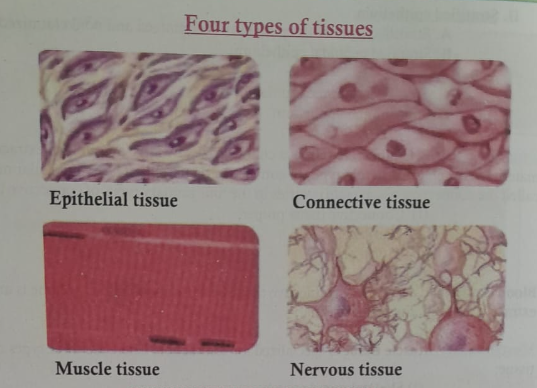
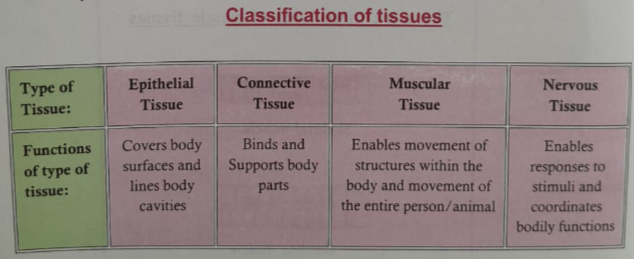
Although our body parts are varied in both structure and function, they are all constructed from four basic tissue types. These four basic tissue typesof primary tissues are:
- Epithelial tissues
- Connective tissues
- Muscle tissues and
- Nervous tissues
Groupings of these four primary tissues into anatomical and functional units are called organs. Organs, in turn, may be grouped together by common functions into systems.
1. Epithelial tissue
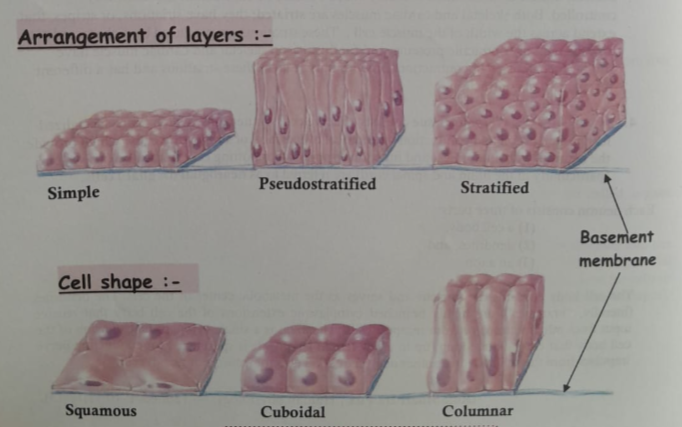
Epithelial tissue consists of cells that form membranes, which cover and line the body surfaces, and of glands, which are derived from these membranes. Epithelial membranes are classified according to the number of their layers and the shape of the cells in the upper layer. Combining the two characteristics (arrangements of layers and cell shapes). the types of covering and lining epithelia are as follows:
I. Simple epithelium
A. Simple squamous epithelium
B. Simple cuboidal epithelium
C. Simple columnar epithelium (nonciliated and ciliated)
D. Pseudostratified columnar epithelium (nonciliated and ciliated)
II. Stratified epithelium
Stratified squamous epithelium (keratinized and nonkeratinized)
Stratified cuboidal epithelium
Stratified columnar epithelium
Transitional epithelium
2. Connective tissue
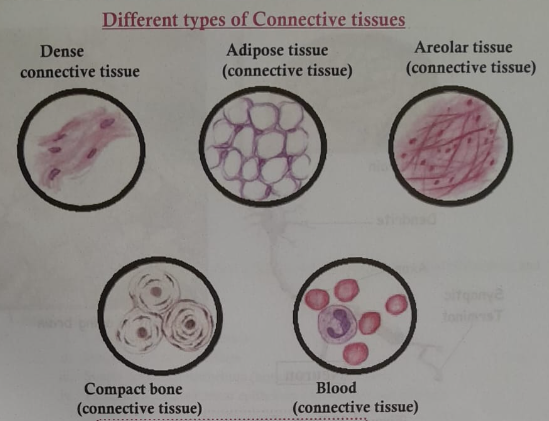
Connective tissue is characterized by large amounts of extracellular material between the different types of connective tissue cells. The extracellular material, called the connective tissue matrix, varies in the four primary types of connective tissues:
(I) Connective tissue proper,
(II) Cartilage;
(III) Bone; and
(IV) Blood.
Blood is classified as a type of connective tissue because about half its volume is an extracellular fluid, the blood plasma
3. Muscle tissue
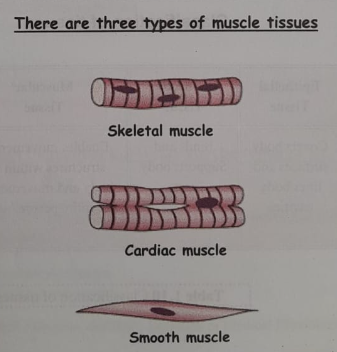
Muscle tissue is specialized for contraction. There are three types of muscle tissue:
(I) Skeletal muscle tissue,
(II) Cardiac muscle tissueand
(III) Smooth muscle tissue.
Skeletal muscle is often called voluntary muscle because its contraction is consciously controlled. Both skeletal and cardiac muscles are striated; they have striations, or stripes, that extend across the width of the muscle cell.
These striations are produced by a characteristic arrangement of contractile proteins, and for this reason skeletal and cardiac muscle have similar mechanisms of contraction. Smooth muscle lacks these striations and has a different mechanism of contraction.
4. Nervous tissue
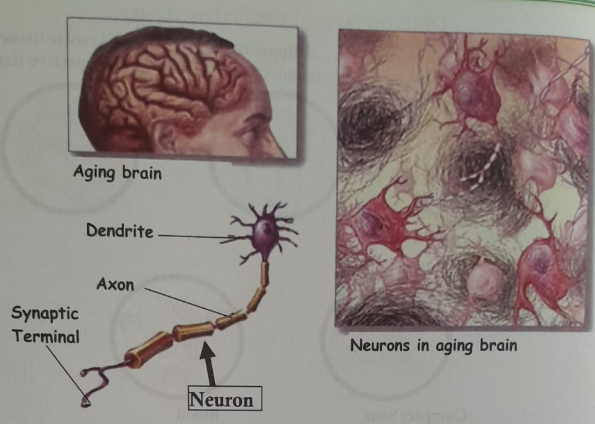
Nervous tissue consists of nerve cells, or neurons, which are specialized for the generation and conduction of electrical events, and of supporting cells, which provide the neurons with anatomical and functional support. Supporting cells in the nervous system (particularly in the brain and spinal cord) are referred to as neuroglial (or glial) cells.
Each neuron consists of three parts:
(1) a cell body,
(2) dendrites, and
(3) an axon.
The cell body contains the nucleus and serves as the metabolic center of the cell. The dendrites (literally, “branches”) are highly branched cytoplasmic extensions of the cell body that receive input from other neurons or from receptor cells.
The axon is a single cytoplasmic extension of the cell body that can be quite long (up to a few feet in length). It is specialized for conducting nerve impulses from the cell body to another neuron or to an effector (muscle or gland) cell.
(Ref: Stuart Ira Fox, Human physiology 12th ed/P-10,11,12,13).
Types of Epithelial Tissue:
A. Covering and Lining Epithelial Tissue:-
a. Classification by Cell Shape:
- Squamous
- Cuboidal
- Columnar
- Transitional
b. Classification by Arrangement of Layers
- Simple Epithelium
- Stratified Epithelium
Combining the two characteristics (arrangements of layers and cell shapes), the types of covering and lining epithelia are as follows:
1.Simple epithelium
i. Simple squamous epithelium
ii. Simple cuboidal epithelium
iii. Simple columnar epithelium (nonciliated and ciliated)
iV. Pseudostratified columnar epithelium (nonciliated and ciliated)
2. Stratified epithelium
i. Stratified squamous epithelium (keratinized andnonkeratinized)
ii. Stratified cuboidal epithelium
iii. Stratified columnar epithelium
iV. Transitional epithelium
B. Glandular Epithelial Tissue:-
a. (Tissue of) Endocrine Glands
b. (Tissue of) Exocrine Glands
Feedback
Feedback is the auto response of a system to an stimulus which is received by that system, ie. it is a link between effector and receptor.
Types: Two type:
- Positive feedback mechanism.
- Negative feedback mechanism.
(Ref.: Guyton and Hall, Textbook of Medical Physiology, 13″ ed,, P-7)