Conflict Resolution – Nursing is a profession within the healthcare sector focused on the care of individuals, families, and communities so they may attain, maintain, or recover optimal health and quality of life. Nurses may be differentiated from other healthcare providers by their approach to patient care, training, and scope of practice. Nurses practice in many specialisms with differing levels of prescriber authority.
Many nurses provide care within the ordering scope of physicians, and this traditional role has shaped the public image of nurses as care providers. However, nurses are permitted by most jurisdictions to practice independently in a variety of settings depending on training level. In the postwar period, nurse education has undergone a process of diversification towards advanced and specialized credentials, and many of the traditional regulations and provider roles are changing.
Nurses develop a plan of care, working collaboratively with physicians, therapists, the patient, the patient’s family, and other team members, that focus on treating illness to improve quality of life. Nurses may help coordinate the patient care performed by other members of an interdisciplinary healthcare team such as therapists, medical practitioners, and dietitians. Nurses provide care both interdependently, for example, with physicians, and independently as nursing professionals.
Conflict Resolution
Definition of Conflict:
According to A.W. Green
“Conflict is the deliberate attempt to oppose, resist or coerce the will of another or others.”
Or,
According to Majumdar
“Conflict is an opposition or struggle involving an emotional attitude of hostility as well as violent interference with autonomous choice.”
According to Horton and Hunt:
“Conflict may be defined as a process of seeking to monopolies rewards by eliminating or weakening the competitors”.
Or,
Conflict refers to some form of friction, disagreement, or discord arising within a group when the beliefs or actions of one or more members of the group are either resisted by or unacceptable to one or more members of another group.
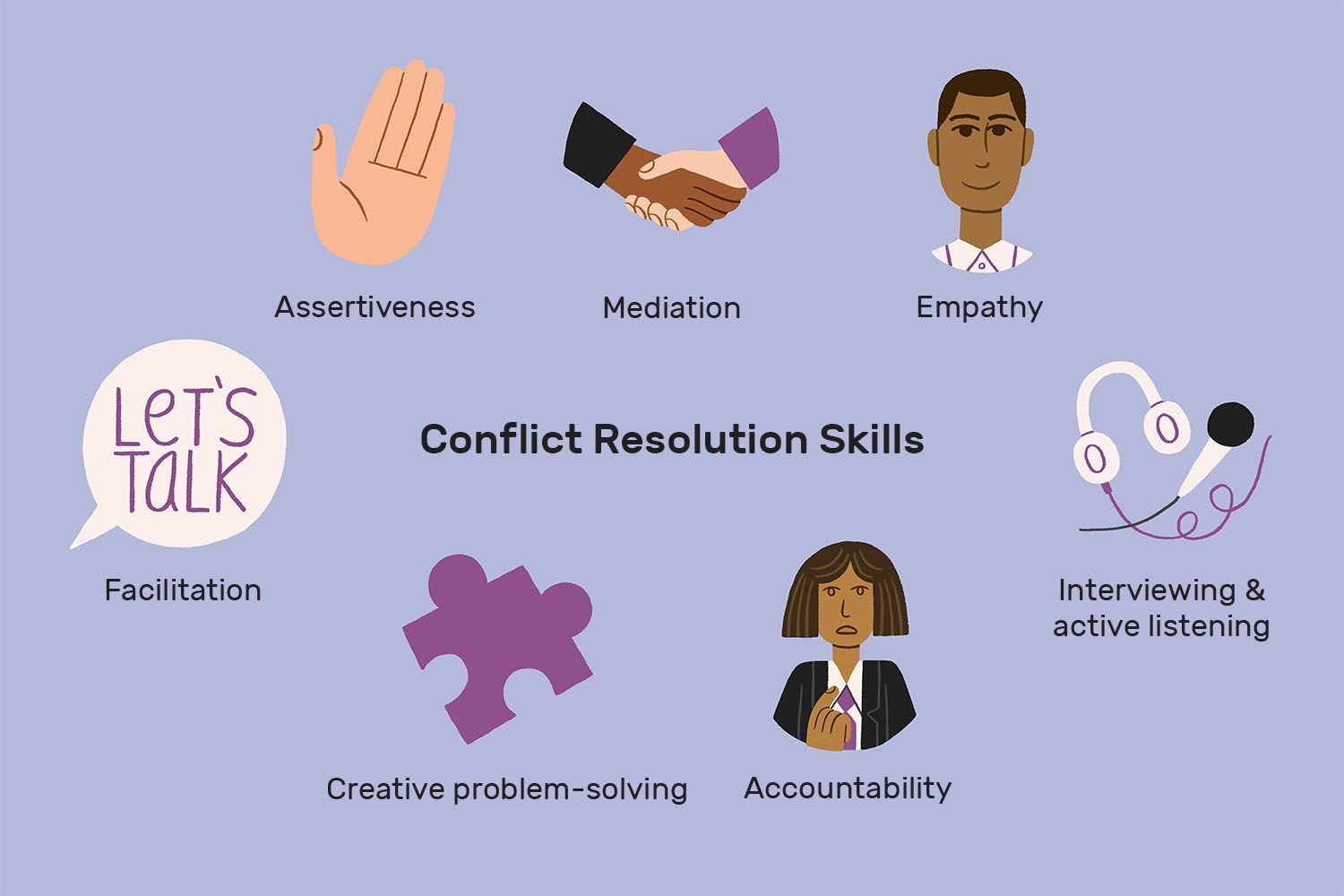
Strategies of Conflict Management:
1. Avoiding: Avoiding not playing attention to the conflict and not taking any action to resolve it.
2. Compromising: Compromising attempting to resolve a conflict by identifying a solution that is partially satisfactory to both parties, but complete satisfactory to neither.
3. Compromise is used to divide the rewards between both parties: Neither gets what he wants. Compromise can serve as a back up to resolve conflict when collaboration is ineffective.it is sometimes the only choice when opponents of equal power are in conflict over to or more mutually exclusive goals. Compromising is also expedient when a solution is needed rapidly.
4. Smoothing: Smoothing is accomplished by complimenting ones opponent down playing differences, and focusing on minor areas of agreement, as if little disagreement exists.
5. Collaborating: Cooperating with the other party to understand their concerns and expressing your own concerns in an effort to find a mutually and completely satisfactory solution. In collaboration the focus is on solving the problem, not defeating the opponent; the goal is to satisfy both parties concerns. Collaboration is useful in situations where the goals of goals of both parties are too important to be compromised.
6. Confrontation: Confrontation technique of resolving conflict is similar to the collaboration technique and is considered to be the most effective means of resolving conflicts. This is problem oriented technique, where the conflict is brought out into the open and attempts are made to solve it through.
7. Negotiation: Negotiation is generally more effective modes of responding to conflict. It moves a give and take on various issues among the parties. It is used in situation in which consensus will never be reached. It often becomes a structured, formal procedure, as in collective bargaining.

Principle of Communication:
- Principle of Clarity in Ideas
- Principle of Appropriate Language
- Principle of Attention
- Language
- Consistency
- Adequacy
- Proper Time
- Informality
- Feedback
- Integration
- Consultation
- Flexibility
- Economy
- Proper Medium
- Understanding
- Brevity
- Timeliness
- Appropriateness
- Constructive and Strategic Use of Informal Groups
- Purpose of Communication
- Physical and Human Setting
- Content of Message
- Follow-Up Action and a Few Others.