Definition of Pulleys – Introduction to fundamental concepts of Biological Science including the organization and common characteristics of living matters, cell structures and functions, food production by photosynthesis, harvesting energy, mechanism of cells reproduction, genetics, evolutions, and Human Biology. Introduction to general chemistry including basic concepts about matter, atomic structure, chemical bonds, gases, liquid, and solids, solutions, chemical reactions, acid, bases, and salt;
organic and biochemistry including hydrocarbons and their derivatives, carbohydrates, lipids, proteins, enzymes, vitamins, and minerals, nucleic acids; principles of physics and applications to nursing including gravity and mechanics, pressure, heat and electricity; nuclear chemistry and nuclear physics, effects of radiation on human beings, and protection and disposal. The aim of the course is to acquire knowledge and skills in general biological science, general chemistry and physics.
Definition of Pulleys
A Pulley consists of a wheel with a grooved rim around which a string can be passed. The pulley rotates about an axel through its centre. The axle is supported by a framework called a block.
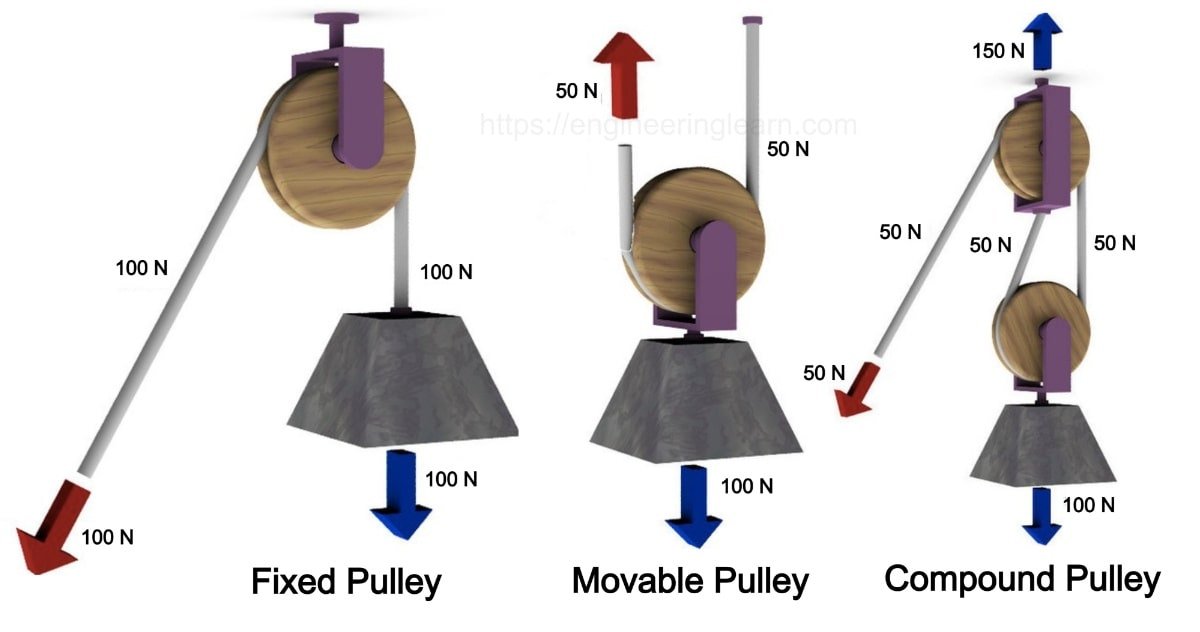
Pulleys are classified as fixed pulleys if they are attached to some fixed support, and movable pulleys if they are attached to the resistance and move along with the resistance. The chief function of the pulley wheel is to equalize the tension of the string on either side of it
Uses/Applications of Pulleys:
- Pulleys are used to lift heavy weights; to open windows move draperies; to raise heavy operating room lamps, and other apparatus in laboratory.
- The chief use of the pulley in therapy is in balanced traction.
- Pulleys are used in the rehabilitation of patients to prevent atrophy of muscles and joints to restore the motion.
- Pulleys are also used to assist the patient in exercising the muscles and joints.