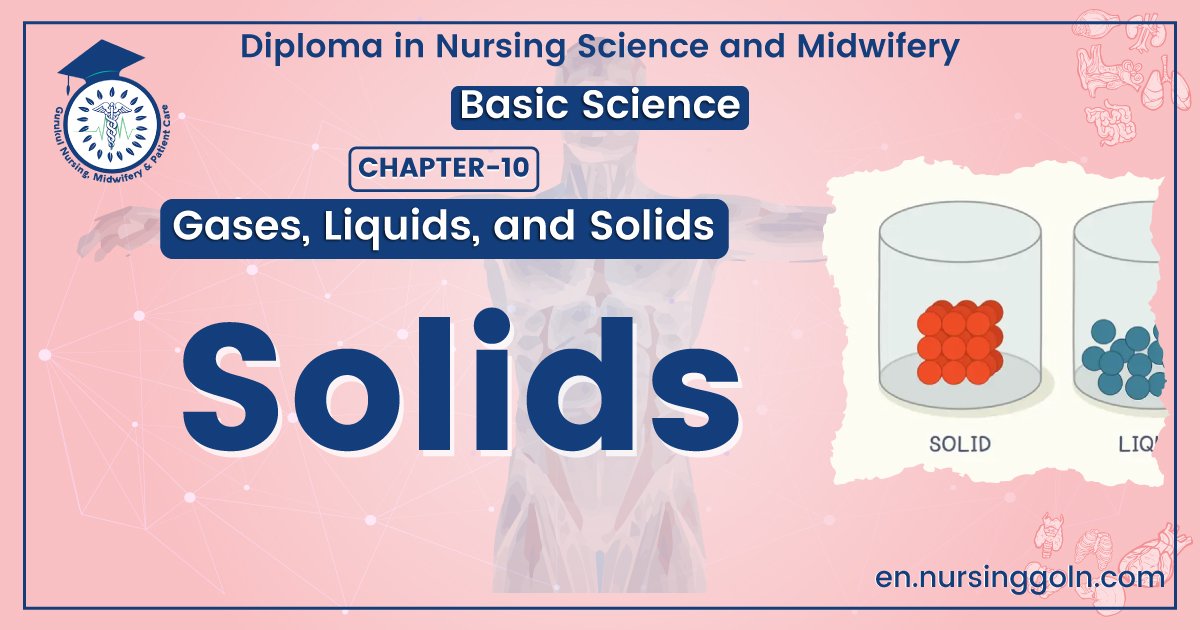
Definition of Solids – Introduction to fundamental concepts of Biological Science including the organization and common characteristics of living matters, cell structures and functions, food production by photosynthesis, harvesting energy, mechanism of cells reproduction, genetics, evolutions, and Human Biology. Introduction to general chemistry including basic concepts about matter, atomic structure, chemical bonds, gases, liquid, and solids, solutions, chemical reactions, acid, bases, and salt;
organic and biochemistry including hydrocarbons and their derivatives, carbohydrates, lipids, proteins, enzymes, vitamins, and minerals, nucleic acids; principles of physics and applications to nursing including gravity and mechanics, pressure, heat and electricity; nuclear chemistry and nuclear physics, effects of radiation on human beings, and protection and disposal. The aim of the course is to acquire knowledge and skills in general biological science, general chemistry and physics.
Solids
A solid is a state of matter characterized by particles arranged such that their shape and volume are relatively stable. The constituents of a solid tend to be packed together much closer than the particles in a gas or liquid. The reason a solid has a rigid shape is that the atoms or molecules are tightly connected via chemical bonds. The bonding may produce either a regular lattice (as seen in ice, metals, and crystals) or an amorphous shape (as seen in glass or amorphous carbon).
A solid is one of the four fundamental states of matter, along with liquids, gases, and plasma. Solid-state physics and solid-state chemistry are two branches of science dedicated to studying the properties and synthesis of solids.
Examples of Solids
The matter with a defined shape and volume is solid. There are many examples:
- A brick
- A penny
- A piece of wood
- A chunk of aluminum metal (or any metal at room temperature except mercury)
- Diamond (and most other crystals)
Examples of things that are not solids include liquid water, air, liquid crystals, hydrogen gas, and smoke.

Definition of Solids:
Solids are one of the four common states of matter – the others are liquids, gases, and plasmas. In general, but not in all specific cases, as the temperature increases and pressure decreases substances pass through the four different states.
Solid -> liquid -> gas -> plasma
or
A solid is a state of matter characterized by particles arranged such that their shape and volume are relatively stable.
Classes/ Types of Solids:
Major classes of solids include:
➤ Minerals: Minerals are natural solids formed by geological processes. A mineral has a uniform structure. Examples include diamond, salts, and mica.
➤ Metals: Solid metals include elements (e.g., silver) and alloys (e.g., steel). Metals are typically hard, ductile, malleable, and excellent conductors of heat and electricity.
➤ Ceramics: Ceramics are solids consisting of inorganic compounds, usually oxides, Ceramics tend to be hard, brittle, and corrosion-resistant. 112
➤ Organic Solids: Organic solids include polymers, wax, plastics, and wood. Most of these solids are thermal and electrical insulators. They typically have lower melting and boiling points than metals or ceramics.
➤ Composite Materials: Composite materials are those which contain two or more phases. An example would be a plastic containing carbon fibers. These materials yield properties not seen in the source components.
➤ Semiconductors: Semiconducting solids have electrical properties intermediate between those of conductors and insulators. The solids may be either pure elements, compounds, or doped materials. Examples include silicon and gallium arsenide.
➤ Nanomaterials: Nanomaterials are tiny solid particles at the nanometer size. These solids may display very different physical and chemical properties from large-scale versions of the same materials. For example, gold nanoparticles are red and melt at a lower temperature than gold metal.
➤ Biomaterials: Biomaterials are natural materials, such as collagen and bone, that are often capable of self-assembly.
Properties of Solids:
Basically five kinds of properties of solids are there. They are:-
- A solid has a definite shape and volume.
- Solids in general have higher density
- In solids, intermolecular forces are strong
- Diffusion of a solid into another solid is extremely slow.
- Solids have high melting points.