Definition of Sterilization – Basic microbiology, parasitology, and immunology; nature, reproduction, growth, and transmission of common microorganisms and parasites in Bangladesh; prevention including universal precaution and immunization, control, sterilization, and disinfection; and specimen collections and examination. Students will have an understanding of common organisms and parasites caused human diseases and acquire knowledge about the prevention and control of those organisms.
Definition of Sterilization
Sterilization can be defined as any process that effectively kills or eliminates transmissible agents (such as fungi, bacteria, viruses and prions) from a surface, equipment, foods, medications, or biological culture medium. In practice sterility is achieved by exposure of the object to be sterilized to chemical or physical agent for a specified time.
Various agents used as steriliants are: elevated temperature, ionizing radiation, chemical liquids or gases etc. The success of the process depends upon the choice of the method adopted for sterilization.
Sterilization is the absolute freeing of an article from any microbial burden including spores.
Or
Sterilization is a process by which all viable microorganisms including their spores are killed or eliminated from a material.
Or
Sterilization is the process of killing or removal of all microorganisms, including bacterial spores, which are highly resistant.
Or
Sterilization is the killing or removal of all microorganisms, including bacterial spores which are highly resistant. Sterilization is an absolute term, i.e. the article must be sterile meaning the absence of all microorganisms.
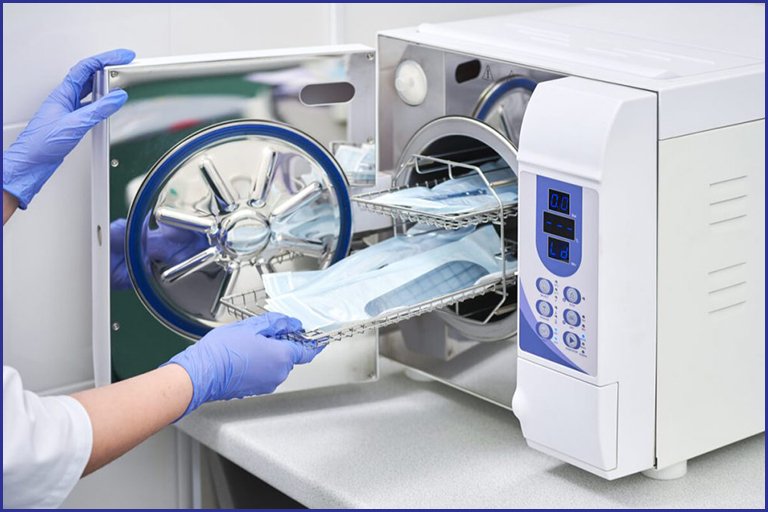
Methods of Sterilization
A. Physical methods
1. Heat
a) Dry heat
- Red heat
- Flaming
- Hot air oven
- Incineration
b) Moist heat
✔ Below 100°C
- Pasteurization (holding method & flash method)
- Vaccine bath (60°C)
- Water bath (56°C)
- Inspissator
✔ At 100° C
- Boiling
- Steaming
- Tyndalization
✔ Above 100°C
- Autoclave (121°C)
2. Radiation
a) Y-ray
b) X-ray
c) UV ray
3. Filtration
a) Berkefeld type
b) Chamberland type
c) Seitz type
d) Membrane filters
4. Ultra-sonication
a) Ultrasound
B. Chemical methods
1. Agents that disrupt membrane
a) Surface active agents e.g. detergents, soap, bile salt.
b) Phenol and phenolic compounds e.g. phenol, cresol, Lysol.
c) Alcohol (70% ethanol)
2. Agents that denature protein
a) Acids and alkalis
3. Agents that inactive group of protein or nucleic acid
a) Heavy metal e.g. silver nitrate, silver sulfadiazine
b) Oxidizing agents e.g. halogen (iodne, cholrine)
c) Dyes e.g. crystal violet.
d) Alkylating agents e.g. formaldehyde, gluteraldehyde, ethylene oxide etc.

Importance of Sterilization
1. To make sterile culture media and different types of equipment’s used in microbiology.
2. To make sterile medical and surgical equipment and thus prevent infection to the patient.
3. Also required in the preparation media and glassware used in the microbiology laboratory
4. Typically the last things to die when one attempts sterilization is the highly heat- (and chemical-, etc.) resistant endospores
5. Prevention of nosocomial infection and infection to doctors and medical staffs by proper hospital disinfection procedure.
Critical Objects
These are objects which enter normally sterile tissue or the vascular system or through which blood flows should be sterile. Critical items have a high risk for infection if they are contaminated with any microorganism.
Example: Surgical instruments, cardiac and urinary catheters, implants and ultrasound probes used in sterile body cavities.
Semi Critical Objects
These objects touch mucous membranes or skin that is not intact. These require a disinfection process (high-level disinfection) that kills all microorganisms but high numbers of bacterial a spores.
Example: Bronchoscope, endoscope, laryngoscope.
Noncritical Objects
These objects touch only intact skin but not mucus membrane. These require low-level disinfection.
Example: Bedpans, blood pressure cuffs, crutches etc.
Places or Substances Where Complete Sterilization is Required
- Operation theatre.
- Operation theatre costume e.g. mask, gown, cap & draping sheet.
- Surgical instruments.
- Catheter,
- Endoscope, cystoscope, bronchoscope etc.
- Different prosthetic materials.
- Microbiology laboratory during specimen collection, inoculation of culture media and subculture.
Use of Sterilization
1. Microbiological uses – Sterilization of media, glass wares and different types of equipment’s
2. Surgical procedures – Sterilization of different instruments.
3. Therapeutic procedures – Sterilization of intravenous fluid, sterilization of different types of instruments (e.g.- needle) for invasive procedures.
4. Diagnostic procedures – Sterile collection of blood, CSF, Urine etc.
Methods of Sterilization Which Can Destroy Bacterial Spores
1. Hot air oven
2. Autoclave
3. Formaldehyde (90-95%)
4. Ionizing radiation (e.g.- a, y UV-rays)
5. Chlorine as hypochlorite
6. Ethylene oxide (EO)
Definition of Steaming
The object to be sterilized is kept in steam at 100°C for 60 minutes. It is not used now.
Methods of steaming
- Koch’s steamer
- Arnold’s steamer
Articles Can be Sterilized by Steaming
- Egg containing media
- Sugar containing media
- Serum containing media
Some Gaseous Chemical Sterilizing Agents with Their Use
| Name | Uses |
| 1. Ethylene oxide | Plastic goods, polythene tube, Cystoscope etc. |
| 2. Gluteraldehyde | Cystoscope, Bronchoscope, Endoscope etc. |
| 3. Formaldehyde gas | Woolen blankets, wools. Foot wear, wards, O.T. etc |
| 4. Hdlogens | As water disinfectants, Surface/Skin disinfectants etc |
| Materials | Methods of sterilization. |
| 1. Culture media |
|
| 2. Powder |
|
| 3. All glass syringes, Glass wares |
|
| 4. Plastic syringe Plastic goods |
|
| 5. Milk |
|
| 6. Operation theater |
|
| 7. Blunt surgical instruments |
|
| 8. Water |
|
| 9. Gloves |
|
| 10. Surgical gauzes |
|
| 11. Endoscope |
|
| 12. Vaseline |
|
| 13. Catheter |
|
Mechanism of Action of Dry Heat
- Denaturation of cell protein.
- Oxidative damage.
- Toxic effect of elevated electrolyte.
Mechanism of action of moist heat
- Loss of functional integrity of cytoplasmic membrane.
- Denaturation and coagulation of structural proteins and enzymes
- Breakage of DNA strands.
Moist Heat is Superior to Dry Heat Due to
- Moist heat has a better penetrating power at a lower temperature.
- It produces latent heat.
- Kills the bacteria by denaturing their enzyme & stmctural proteins.
- Bacteria are more susceptible to moist heat.