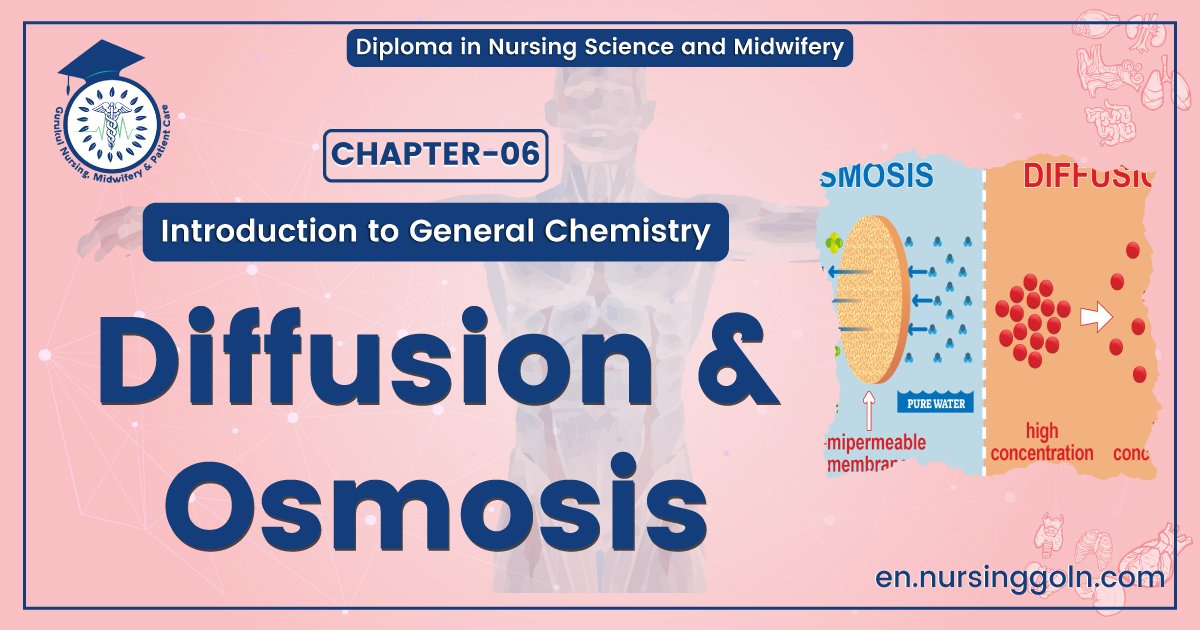
Diffusions and Osmosis-The course is designed for the basic understanding of anatomical structures and physiological functions of human body, musculoskeletal system, digestive system, respiratory system; cardiovascular system; urinary system, endocrine system, reproductive system, nervous system, hematologic system, sensory organs, integumentary system, and immune system. The aim of the course is to acquire knowledge and skills regarding anatomy and physiology.
Diffusions and Osmosis
DIFFUSION
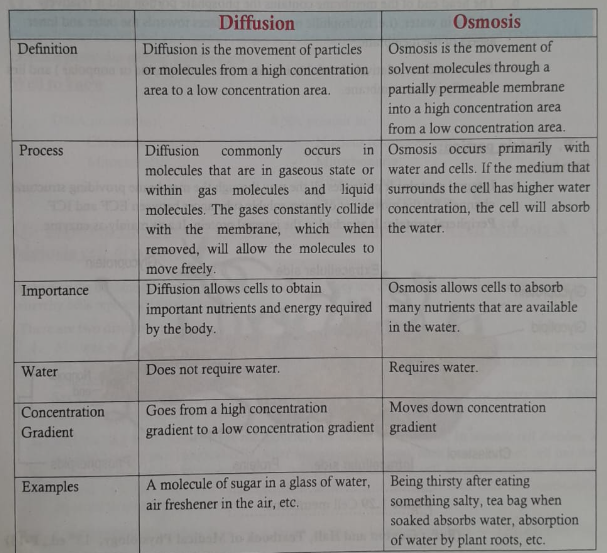
The continuous movement of molecules in a solution from a higher concentration to a lower concentration is called Diffusion. The energy that causes diffusion is the energy of the normal kinetic motion of the solute molecules.
Types of Diffusion with example:
a) Simple diffusion: Here the movement of molecules occurs without the help of carrier protein, e.g- O, CO, transport etc.
b) Facilitated diffusion: Here the movement of molecules occur with the help of carrier protein. e.g- Glucose transport.
Physiological importance of Diffusion:
- Exchange of O2 & CO2 in lungs and tissues occurs by diffusion.
- Absorption of water soluble vitamins, minerals etc from GIT occurs by diffusion.
- Exchange in the capillary occurs by diffusion.
- Secretion of waste product (e.g. ammonia) into renal tubules occurs by diffusion.
- Diffusion of Na & K’ through Na – K’ leak channel creates resting membrane potential.
- Pneumonia thickness of alveolar membrane diffusion of O₂→ hypoxia.
OSMOSIS
The migration of solvent molecules from the region of lower solute concentration to the region of higher solute concentration across a semi permeable membrane is called osmosis
Importance of osmosis:
A. Physiological:
- Absorption from GIT.
- Fluid exchange in the capillary bed.
- Regulation of urine formation
- Reabsorption of CSF
- Maintenance of Blood pressure.
B. Clinical:
- Infusion: Isotonic solutions of NaCI (0.9%) or glucose (5%) are commonly used as infusion in hospitals for the treatment of dehydration, burn etc.
- Action of Purgatives: Purgatives (e.g. MgSO) prevent water absorption by osmosis from GIT. Thus they cause dilution of intestinal content and helps in defecation.
Osmotic pressure:
The amount of pressure required to prevent osmosis completely is called osmotic pressure. Osmotic pressure causes fluid movement by osmosis from the interstitial space into the blood. It is measured as Osmole/L or milliosmole/L. The plasma colloidal osmotic pressure is 280-300 mOsm/L.
[N.B: The opposite of osmotic pressure is ‘hydrostatic pressure. Hydrostatic pressure causes movement of solute & fluid from the capillary blood to the interstitial space.]