
Eriksons psychosocial stages of development throughout the lifespan – Behavioral sciences explore the cognitive processes within organisms and the behavioral interactions between organisms in the natural world. It involves the systematic analysis and investigation of human and animal behavior through the study of the past, controlled and naturalistic observation of the present and disciplined scientific experimentation and modeling.
It attempts to accomplish legitimate, objective conclusions through rigorous formulations and observation. Generally, behavior science deals primarily with human action and often seeks to generalize about human behavior as it relates to society.
Eriksons psychosocial stages of development throughout the lifespan
Every person has his or her own unique identity. This identity is composed of the different personality traits that can be considered positive or negative. These personality traits can also be innate or acquired, and they vary from one person to another based on the degree of influence that the environment has on the individual. The bottom line is that as human beings, we possess many characteristics that are honed in many different aspects that eventually define who we are.
Erik Erikson’s Theory of Psychosocial Development emphasizes the sociocultural determinants of development and presents them as eight stages of psychosocial conflicts (often known as Erikson’s stages of psychosocial development) that all individuals must overcome or resolve successfully in order to adjust well to the environment.
According to Erik Erikson’s theory, we all encounter a certain crisis that contributes to our psychosocial growth at each of Erikson’s stages of psychosocial development. Whenever we experience such crisis, we are left with no choice but to face it and think of ways to resolve it. Failure to overcome such crisis may lead to significant impact on our psychosocial development.
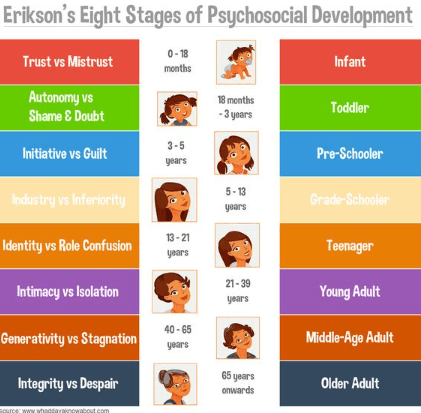
Erikson’s Psychosocial Stages (1959) of Development throughout the Life Span:
| Age (stage) | Developmental task | Central issue | Significant relation | Favorable outcome |
| 1. 0-18 months (Infancy) | Trust vs. Mistrust | Testing of the trustworthiness of the infant’s significant others | Mother | Hope, trust optimism |
| 2. 18 months-3 years (Early childhood) | Autonomy vs. doubt | Testing of the individual capabilities in relation to significant others | Parents | Self-control, adequacy |
| 3. 3-5 years (Middle childhood) | Initiative vs. Guilt | Testing out abilities to compete in the outside world | Basic Family | Purpose, initiates own activities |
| 4. 5-12 years (Late childhood) | Industry vs. Inferiority | Gaining mastery of cultural tools | School | Competence Developing intellectual social Physical skills |
| 5. 13-19 years (Adolescence) | Identity vs. Role confusions | Developing a sense of personal identity | Peer Groups | Awareness of self as a unique individual |
| 6. 20-40 years (Early adulthood) | Intimacy vs. Isolation | Merging of identity with another to achieve intimacy | Friends | Forming close relationships, making career, commitment |
| 7. 40-65 years (Mature adulthood or middle age) | Generativity vs. Stagnation | Investing creative energies in’ promoting the social welfare | Household | Care Concern for family and society |
| 8. 65-Death (old age) | Ego integrity vs. Despair | Acceptance of the life one has lived as worthwhile | Mankind | Satisfaction with life |
Stage One-Trust vs. Mistrust
The first stage of the Erikson stages starts from infant to about 18 months. At this stage, infants must learn how to trust others, particularly those who care for their basic needs. They should feel that they are being cared for and that all their needs are met.
Small babies are new to this world and may view the outside world as threatening. Depending on how they are treated by people around them, the sense of threat can be replaced by trust. When this happens, they gain a sense of security and begin to learn to trust people around them.
The first and most important person to teach an infant about trust is usually the parents. Parents are expected to take good care of their children and attend to their needs. For example, the parents of a baby provide him with food, shelter, sustenance and make him feel very comfortable and secure.
Stage Two-Autonomy vs. Shame and Doubt
daudb ni siqooq To At stage two of the Erikson stages, children should be taught the basic ways of taking care of themselves, including changing their clothes and feeding themselves. If a child can’t take care of his own basic needs and continue to rely on others to take care of him, he may feel shameful when he sees that other kids of his own age are able to perform tasks such as feeding themselves.
Stage Three-Initiative vs. Guilt
As children continue to grow up, they like to explore and do things on their own. At stage three of the Erikson stages, children can learn new concepts introduced in school and are expected to practice these lessons in real life. They know that they can accomplish these tasks on their own, but if they fail to do so and end up asking for assistance from others, they may feel a sense of guilt.
Stage Four-Industry vs. Inferiority
At Erikson’s psychosocial stage four, children mature and their level of self-awareness increases. They understand logical reasoning, scientific facts, and other matters that are typically taught in school.
Children also become more competitive during this Erikson stage of development. They want to do things that other children of the same age can do. When they make the effort to perform a task and succeed, they develop self-confidence. However, if they fail, they tend to feel that they are inferior to others.
Stage Five-Identity vs. Role Confusion
During adolescence, young people are expected to develop their sexual identity. This is gained through the discovery of oneself and in the course of finding meaning to their personhood. They may also experience identity crisis as a result of the transition from childhood to adulthood.
Some adolescents may feel confused and are unsure whether an activity is age-appropriate for them. Crisis at this stage may also be brought about by expectations from themselves and from people around them, e.g. their parents.
Stage Six-Intimacy vs. Isolation
Stage six of the Erikson stages is very apparent for young adults who are in their 30s. People at this stage become worried about finding the right partner and fear that if they fail to do so, they may have to spend the rest of their lives alone.
Young adults are most vulnerable to feel intimacy and loneliness because they interact with a lot of people in this phase of their lives. It’s not always a success story for every young adult to find someone with whom they can share a lifelong commitment. Some may choose to spend the rest of their lives as singles.
Stage Seven-Generativity versus Stagnation
Adults who are in their 40s and 50s tend to find meaning in their work. They feel like at this point in their lives, they should be able to contribute something meaningful to the society and leave a legacy. If they fail to achieve this, they feel like they have been an unproductive member of the society.
Stage Eight-Ego Integrity vs. Despair
At the last stage of the Erikson stages, people are in their 60s or older who are typically retirees. It is important for them to feel a sense of fulfillment knowing that they have done something significant during their younger years. When they look back in their life, they feel content, as they believe that they have lived their life to the fullest. If they feel that they haven’t done much during their life, it’s likely that they will experience a sense of despair.