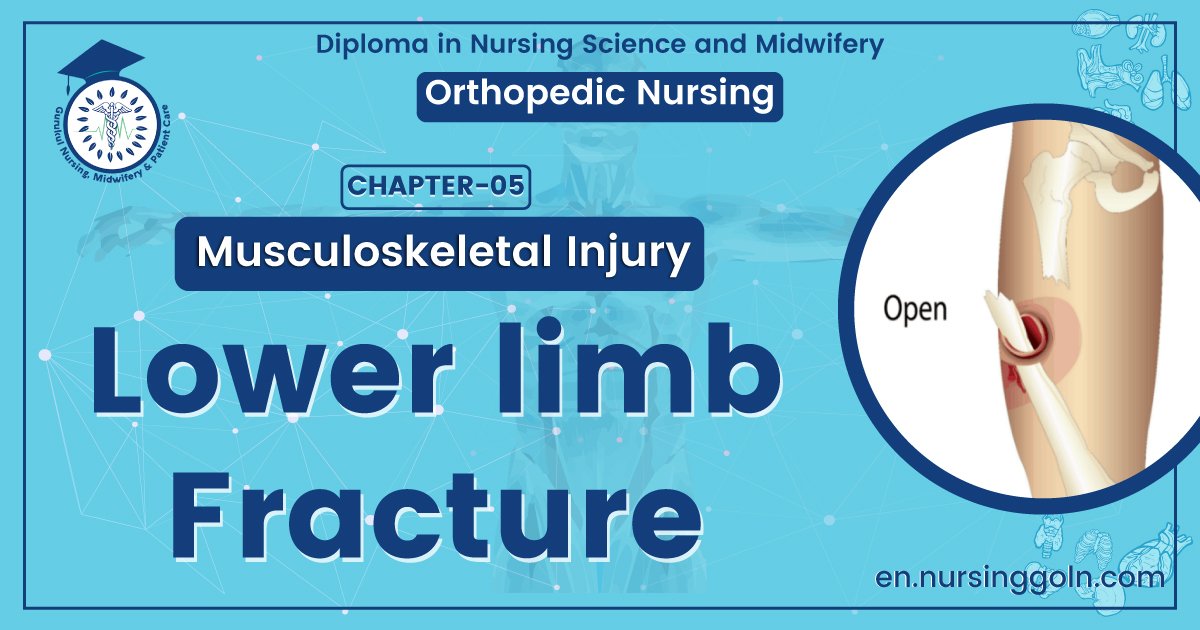
Lower limb fracture – An orthopedic nurse is a nurse who specializes in treating patients with bone, limb, or musculoskeletal disorders. Nonetheless, because orthopedics and trauma typically follow one another, head injuries and infected wounds are frequently treated by orthopedic nurses.
Ensuring that patients receive the proper pre-and post-operative care following surgery is the responsibility of an orthopedic nurse. They play a critical role in the effort to return patients to baseline before admission. Early detection of complications following surgery, including sepsis, compartment syndrome, and site infections, falls under the purview of orthopedic nurses.
Lower limb fracture | CHAPTER 5 | Orthopedic Nursing
The tension at which a specimen fractures is called fracture strength, sometimes referred to as breaking strength.A tensile test, which plots the stress-strain curve (see image), is typically used to determine this for a particular specimen. The fracture strength is the last documented point.
The fracture strength of brittle materials is equal to the UTS, while the fracture strength of ductile materials is less than the UTS.[2] In a load-controlled scenario, a ductile material that reaches its ultimate tensile strength will continue to deform without further load application until it ruptures. However, the material’s deformation may relieve the load and prevent rupture if the loading is displacement-controlled .

Architects and engineers have long recognized the fascinating behavior of fracture statistics in random materials. Fracture or breakdown studies are, in fact, among the oldest fields of physical research, and they are still highly relevant today. More than 500 years ago, Leonardo da Vinci noted that as iron wire length increases, the tensile strengths of ostensibly equivalent specimens fall (see e.g.,for a recent debate). Galileo Galilei made similar observations almost 400 years ago. This represents an extreme failure statistics manifestation (larger sample volumes can have higher flaws because of cumulative fluctuations where failures nucleate and decreased sample strength is induced).
Common fracture of the lower limb :
1) Pelvic fracture.
2) Femur fracture: Neck & shaft
3) Patella fracture.
4) Tibia fracture.
5) Fibula fracture.
6) Talus fracture.
7) Metatarsal fracture and
8) Phalanges fracture.
