
Patient lifting and transferring – Nursing is a profession within the healthcare sector focused on the care of individuals, families, and communities so they may attain, maintain, or recover optimal health and quality of life. Nurses may be differentiated from other healthcare providers by their approach to patient care, training, and scope of practice. Nurses practice in many specialisms with differing levels of prescriber authority.
Many nurses provide care within the ordering scope of physicians, and this traditional role has shaped the public image of nurses as care providers. However, nurses are permitted by most jurisdictions to practice independently in a variety of settings depending on training level. In the postwar period, nurse education has undergone a process of diversification towards advanced and specialized credentials, and many of the traditional regulations and provider roles are changing.
Nurses develop a plan of care, working collaboratively with physicians, therapists, the patient, the patient’s family, and other team members, that focus on treating illness to improve quality of life. Nurses may help coordinate the patient care performed by other members of an interdisciplinary healthcare team such as therapists, medical practitioners, and dietitians. Nurses provide care both interdependently, for example, with physicians, and independently as nursing professionals.
Patient lifting and transferring
Definition of Patient Transfer:
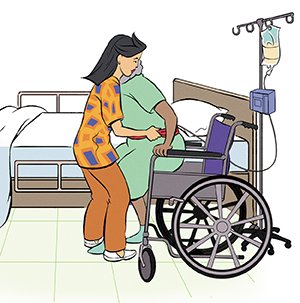
Transfers are defined as moving a patient from one flat surface to another, such as from a bed to a stretcher. Types of hospital transfers include bed to stretcher, bed to wheelchair, wheelchair to chair, and wheelchair to toilet, and vice versa.
Transfer the Patient from Bed to Stretcher:
Always predetermine the number of staff required to safely transfer a patient horizontally.
1. Explain what will happen and how the patient can help (tuck chin in, keep hands on chest).
2. Collect supplies.
3. Raise bed to safe working height. Lower head of bed and side rails.
4. Position the patient closest to the side of the bed where the stretcher will be placed.
5. Roll patient over and place slider board halfway under the patient, forming a bridge between the bed and the stretcher.
6. Place sheet on top of the slider board. The sheet is used to slide patient over to the stretcher.
7. The patient is returned to the supine position.
8. Patient’s feet are positioned on the slider board. Position stretcher beside the bed on the side closest to the patient, with stretcher slightly lower. Apply brakes.
9. Two health care providers climb onto the stretcher and grasp the sheet. The lead person is at the head of the bed and will grasp the pillow and sheet. The other health care provider is positioned on the far side of the bed, between the chest and hips of the patient, and will grasp the sheet with palms facing up.
10. The two caregivers on the stretcher grasp the draw sheet using a palms up technique, sitting up tall, and keeping their elbows close to their body and backs straight.
11. The caregiver on the other side of the bed places his or her hands under the patient’s hip and shoulder area with forearms resting on bed.
12. The caregiver on the other side of the bed places his or her hands under the patient’s hip and shoulder area with forearms resting on bed.
13. The designated leader will count 1, 2, 3, and start the move.msing id nem boy ob tad W.
14. The person on the far side of the bed will push patient just to arm’s length using a back-to-front weight shift.
15 . At the same time, the two caregivers on the stretcher will move from a sitting-up-tall position to sitting on their heels, shifting their weight from the front leg to the back, bringing the patient with them using the sheet.
16. The two caregivers will climb off the stretcher and stand at the side and grasp the sheet, keeping elbows tucked in.
17. One of the two caregivers should be in line with the patient’s shoulders and the other should be at the hip area.
18. On the count of three, with back straight and knees bent, the two caregivers use a front-to-back weight shift and slide the patient into the middle of the bed.
19. At the same time, the caregiver on the other side slides the slider board out from under the patient.
20. Replace pillow under head, ensure patient is comfortable, and cover the patient with sheets.
21. Lower bed and lock brakes, raise side rails as required, and ensure call bell is within reach.
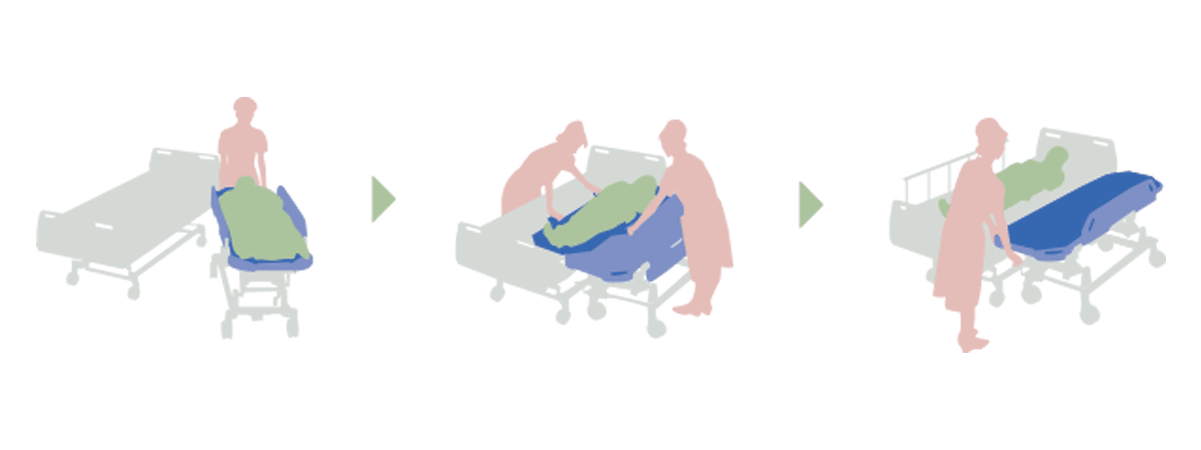
Procedure of Transferring the Patient from Bed to Stretcher