
Psychoanalytic theory – This book covers the entire syllabus of “Psychiatric Nursing” prescribed by the Universities of Bangladesh- for Basic and diploma nursing students. We tried to accommodate the latest information and topics. This book is an examination-friendly setup according to the teachers’ lectures and examination questions.
At the end of the book previous university questions are given. We hope in touch with the book students’ knowledge will be upgraded and flourish. The unique way of presentation may make your reading of the book a pleasurable experience.
Psychoanalytic theory
“No body of knowledge approaches psychoanalytic theory in terms of its capacity to explain the mysteries of the human mind.” – GLEN O. GABBARD
Introduction
1. Psychoanalytic theory was developed by Sigmund Freud (1856-1939).
2. Psychoanalytic theory revolutionized the understanding of mental life and human behavior.
3. Freud’s theories helped in understanding early development of sexuality and mental functioning in the infant and adult psychological illnesses.
Freud’s Theories
Psychoanalytic theory includes:
1. Structural Theory
2. Libido (Drive) Theory
3. Topographical Theory of mind
4. Theory of Narcissism
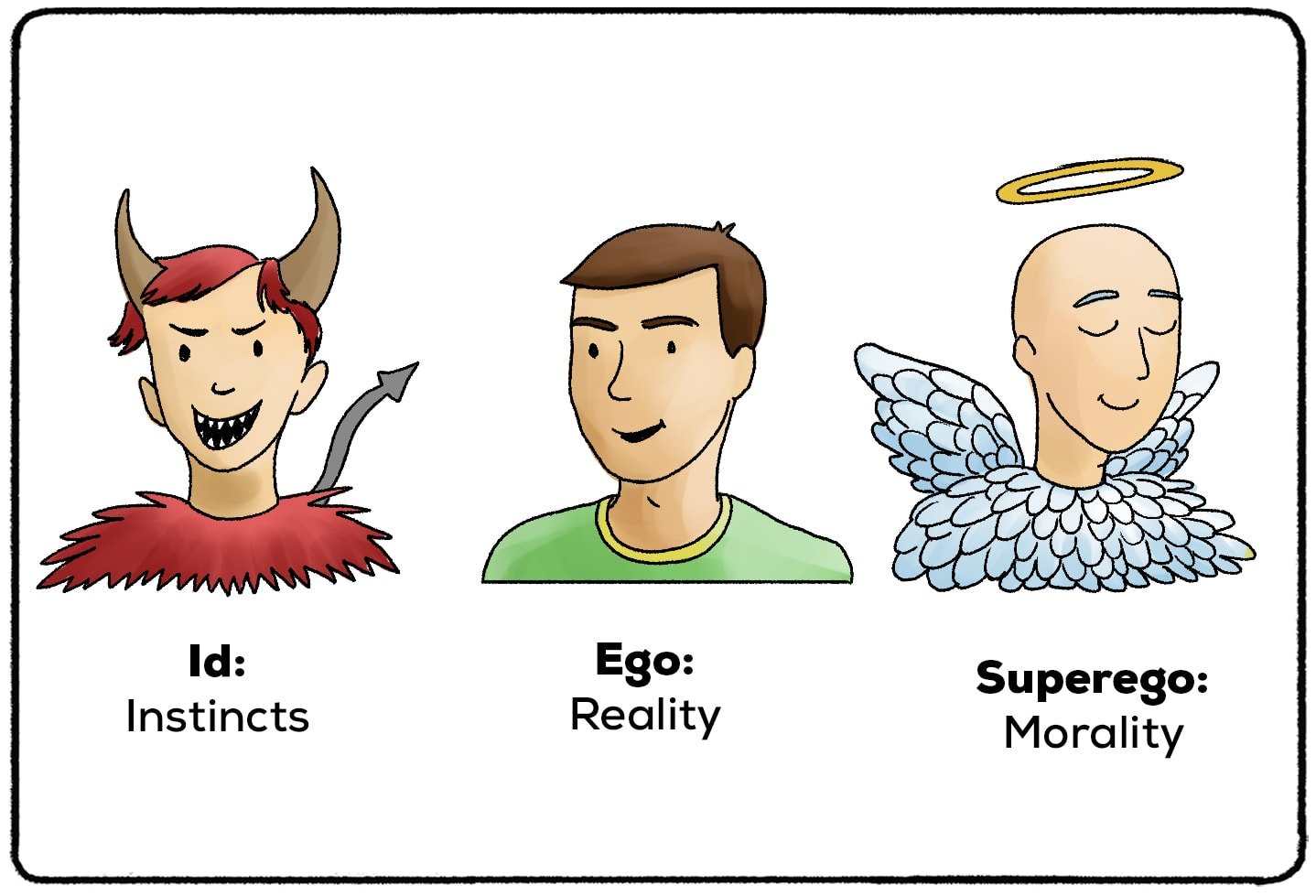
A. Structural (Tripartite) Theory
“In mental life, nothing which has once been formed can perish everything is somehow preserved and in suitable circumstances. it can once more be brought to light.” (Freud, 1930)
Freud’s structural theory postulated the existence of the id, ego, and superego.
Id:
- First to develop
- Completely unconscious
- Contains all drives
- Ruled by pleasure principle
- No awareness of reality
Ego:
- Second structure to develop
- Operates on reality principle
- Mediates conflict among id, ego, and superego
- Provides reality testing
- Monitor’s quality of interpersonal relations
- Provides synthesis and coordination
- Carries out primary autónomous functions
- Defends against anxiety
Superego:
- Third structure to develop
- Self-criticism based on moral values
- Self-punishment.
- Self-praise based on ego ideal
- Most functions are unconscious
Conflict is the main concept of structural theory.
B. Libido Theory
- Libido theory assumes that biological “needs” (drives) fuel behavior.
- The aim of behavior is to gratify the drive.
- Drives are either sexual or aggressive in nature.
- The libido theory explains that the sexual instinct plays an etiological role in the neuroses and that sexual stimulation exerts a predominant force (which is called libido) on mental activity throughout life.
- The discharge of libido is experienced as pleasure.
C. Topographical Theory
- Topographical theory explains three regions of mental functioning or systems of the mind exist as defined by their relationship to conscious thought:
✓ the conscious,
✓ preconscious, and
✓ Unconscious. - Conscious level of mind refers to the portion of mental activity and content that is directly available to immediate perception.
- Preconscious level of mind refers to mental content and processes that are not conscious but can be readily accessed by the direction of attention.
- Unconscious level of mind refers to a set of mental processes and content that operates outside conscious awareness.
D. Theory of Narcissism
- Narcissism refers to excessive love or admiration of oneself or self-love.
- The term also refers to the erotic pleasure derived from contemplation or admiration of one’s own body or self, especially as a fixation on or a regression to an infantile stage of development.
- Freud explained his theory of narcissism in his seminal paper “On Narcissism: An Introduction” (Freud, 1914).
- Freud explains primary and secondary narcissisms, which emerge in normal human
development. - Primary narcissism refers to the state in which the desire and energy that drive one’s instinct to survive.
- Secondary narcissism occurs when the libido withdraws from objects outside the self, above all the mother, producing a relationship to social reality that includes the potential for megalomania.
- Problems in the transition from one to the other can lead to pathological narcissistic disorders in adulthood.
