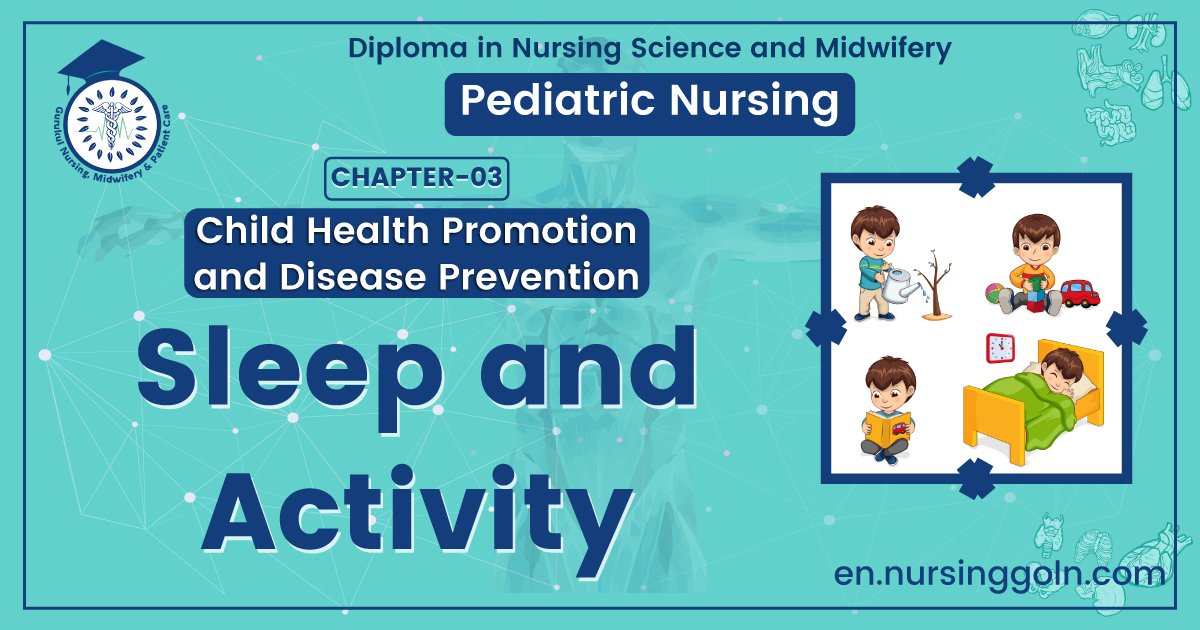
Sleep and activity – Health of the children has been considered as the vital importance to all societies because children are the basic resource for the future of humankind. Nursing care of children is concerned for both the health of the children and for the illnesses that affect their growth and development. The increasing complexity of medical and nursing science has created a need for special area of child care, i.e. pediatric nursing.
Pediatric nursing is the specialized area of nursing practice concerning the care of children during wellness and illness. It includes preventive, promotive, curative and rehabilitative care of children. It emphasizes on all round development of body, mind and spirit of the growing individual. Thus, pediatric nursing involves in giving assistance, care and support to the growing and developing children to achieve their individual potential for functioning with fullest capacity.
Sleep and activity
Definition of Sleep:
A condition of body and mind such as that which typically recurs for several hours every night, in which the nervous system is relatively inactive, the eyes closed, the postural muscles relaxed, and consciousness practically suspended.
Or
Sleep is a state of unconsciousness without any pathological cause to restore expended nerve energy.
Or
Sleep is a naturally recurring state characterized by reduced or absent consciousness, relatively suspended sensory activity, and inactivity of nearly all voluntary muscles.
Changes that Occur During Sleep:
Night Terrors
Night terrors are episodes of screaming, intense fear and flailing while still asleep. Also known as Sleep terrors, sleep terrors often are paired with sleepwalking. Like sleepwalking, sleep terrors are considered a parasomnia an undesired occurrence during sleep.
Night Mares:
A nightmare, also called a bad dream, is an unpleasant dream that can cause a strong emotional response from the mind, typically fear but also despair, anxiety and great sadness. The dream may contain situations of discomfort, psychological or physical terror.
Benefit of Sleep:
1. The regeneration of nerve energy.
2. Refueling the liver and cells with glycogen.
3. Experiments with electro sleep indicate that the body generates low level electricity during sleep.
4. Destruction of old cells and replacement with new cells (Multiplication of cells occurs during sleep at a rate of more than twice that during walking hours).
5. The body expels more debris and wastes during sleep and rest than when active.
6. Many other beneficial purposes are also served during sleep. The physiological rest obtained during sleep is extraordinarily valuable. During the prolonged rest of sleep, the body restocks its cells and organs with fuel, replaces cells that have lost their vitality and rids itself of extraordinary toxins that may have been un-eliminated the previous day.
7. The body generates low level.
Types of Sleep:
Sleep is divided into two broad types:
- Rapid eye movement (REM) sleep.
- Non rapid eye movement (NREM or non-REM) sleep.
Need of Sleep of a Person
| Age and condition | Sleep Needs |
| Newborns (0-2 months) | 12 to 18 hours |
| Infants (3-11 months) | 14 to 15 hours |
| Toddlers (1-3 years) | 12 to 14 hours |
| Preschoolers (3-5 years) | 11 to 13 hours |
| School-age children (5-10 years) | 10 to 11 hours |
| Adolescent (10-17 years) | 1.5 to 9.25 hours |
| Adults, including elderly | 7 to 9 hours |
| Pregnant women | 8(+) hours |
Night Mares
Definition of Night Mares:
A nightmare, also called a bad dream, is an unpleasant dream that can cause a strong emotional response from the mind, typically fear but also despair, anxiety and great sadness. The dream may contain situations of discomfort, psychological or physical terror.
Causes of Night Mares:
Nighttime fears and nightmares are extremely common in children, especially during the preschool years, but they can definitely occur in older children and adolescents as well. They are part of normal development, as children’s imaginations develop and children begin to understand that there are things that exist that can hurt them.
There are times that fears and nightmares are the result of a frightening experience, from being scared by a large dog to being in a car accident to watching the news, but other times they seem to come out of the blue. Family conflict and parental anxiety can also play a role. Anything that makes a child more emotionally aroused is going to make his fears worse and make him feel more anxious. Children also typically have different fears at different developmental stages. Young children are often afraid of monsters and other imaginary creatures, whereas older children are more likely to fear being hurt by more realistic dangers, such as burglars or a natural disaster.
Nightmares are only considered a disorder if disturbing dreams cause you distress or keep you from getting enough sleep. Nightmares can be triggered by many factors, including:
- Stress: Sometimes the ordinary stresses of daily life, such as a problem at home or school, trigger nightmares. A major change, such as a move or the death of a loved one, can have the same effect.
- Trauma: Nightmares are common after an accident, injury or other traumatic event. Nightmares are prominent in post-traumatic stress disorder (PTSD).
- Sleep deprivation: Changes in your schedule that cause irregular sleeping and waking times or that interrupt or reduce the amount of sleep can increase your risk of having nightmares.
- Medications: Some drugs including certain antidepressants, blood pressure medications, beta blockers, and drugs used to treat Parkinson’s disease or to help you stop smoking can trigger nightmares.
- Substance abuse: Alcohol and illegal drug use or withdrawal can trigger nightmares.
- Scary books and movies: Reading scary books or watching scary movies, especially before bed, can be associated with nightmares.
- Other disorders: Some medical conditions and mental health disorders as well as other sleep disorders can be associated with having nightmares. For instance, anxiety can be associated with a higher likelihood of recurrent nightmares.
Night Terrors
Definition Of Night Terrors
Night terrors are episodes of screaming, intense fear and flailing while still asleep. Also known as Sleep terrors, sleep terrors often are paired with sleepwalking. Like sleepwalking, sleep terrors are considered a parasomnia an undesired occurrence during sleep.
Or
In night terrors, the child awakens during sleep, sits up with screaming and terrified to recognize the surrounding and after sometimes sleeps again.
Causes Night Terrors
The cause of night terrors is often unknown, but the condition may result from lack of sleep or high levels of stress. Conflict and tension in the home is one example of a stressor that may bring on night terrors in children.
Night Terrors in Children:
Childhood night terrors appear to be a normal part of the immature nervous system developing. This may cause the fight-or-flight response to occur at the wrong times. Children spending the night in an unfamiliar place may also be more likely to experience night terrors. Children typically grow out of night terrors without psychiatric intervention.
Symptoms of Night Terrors:
Sleep terrors differ from nightmares. The dreamer of a nightmare wakes up from the dream and may remember details, but a person who has a sleep terror episode remains asleep.
Children usually don’t remember anything about their sleep terrors in the morning. Adults may recall a dream fragment they had during the sleep terrors. Also, nightmares generally occur in the last half of the night, while
sleep terrors occur in the first half of the night.
- During a sleep terror episode, a person might:
- Partially or fully awakening from sleep very suddenly.
- Sit up in bed.
- Scream or shout.
- Kick and thrash.
- Sweat, breathe heavily and have a racing pulse.
- Be hard to awaken, but if awakened be confused.
- Be inconsolable.
- Stare wide-eyed.
- Elevated blood pressure.
- Get out of bed and run around the house.
- Engage in aggressive behavior (more common in adults).
Comparison of Night Terrors and Nightmares:
| Factor | Night Terrors | Night Mares |
| Age | 3-8 years | Any age |
| Gender | Male predominance | Either |
| Occurrence in sleep cycle | NREM (non-rapid eye movement) | REM (rapid eye movement) |
| Arousable | No | Yes |
| Memory for event | None | Yes |
| Exacerbated by stress | Yes | Yes |
Prevention of sleep disorders:
Sleep disorders are common in children with anxiety, tension and over activity. These problems are present with or without physical symptoms of behavioral disorders. By the following way we can prevent sleep disorders-
- No exciting games and pictures and frightening stories (ghost, murder, accidents) should not be allowed at night.
- Parents should allow relax comfortable bed and emotionally healthy environment to the child.
- In case of sleep walking, door and windows to be kept closed and dangerous objects to be removed.
- In advanced and prolonged problems consultation with doctors and psychologists is essential for specific drug therapy and psychotherapy.