Definition of Virus – Basic microbiology, parasitology, and immunology; nature, reproduction, growth, and transmission of common microorganisms and parasites in Bangladesh; prevention including universal precaution and immunization, control, sterilization, and disinfection; and specimen collections and examination. Students will have an understanding of common organisms and parasites caused human diseases and acquire knowledge about the prevention and control of those organisms.
Definition of Virus
Viruses are unique group of living agents, extremely small in size, usually beyond the resolution of a light microscope, possess highest state of parasitism containing single molecule of either DNA or RNA which has a protein shell and multiply by replication within the living cell.
Or
Viruses are particles composed of an internal core containing either DNA or RNA (but not both) covered by a protective protein coat.
Or
A virus is a small infectious agent that replicates only inside the living cells of other organisms. Viruses can infect all types of life forms, from animals and plants to microorganisms, including bacteria and archaea.
Definition of Virion:
Virion is the complete virus particle that is structurally intact and infectious. The virion is either a naked or an enveloped nucleocapsid.
Definition of Viroids:
Viroids consist solely of a single molecule of circular RNA without a protein coat or envelope. The RNA is quite small (MW-1X10⁵) and apparently does not code for any protein. They are only infective to plants & not to human.
Definition of Pseudovirus:
Pseudo viruses contain host cell DNA instead of viral DNA within the capsid. It can infect cell but cannot replicate. They are formed during infection with certain viruses when the host cell DNA is fragmented & pieces of it are incorporated within the capsid protein.
Difference between Virus & Bacteria;
| Traits | Virus | Bacteria |
| Size | Below 300 nm, small pox vims is largest (300 nm) | Above 300 nm (e.g. Staphylococcus- 1000 nm) |
| Site | Usually intracellular | Extracellular or intracellular. |
| Nucleic acid | Either DNA or RNA, never both. | Both DNA & RNA. |
| Ribosome | Absent | Present. |
| Outer surface | Protein capsid & lipoprotein envelops | Rigid wall containing peptidoglycan layer |
| Microscopy | Not seen by light microscope | Usually seen by light microscope |
| Multiplication | Not seen by light microscope | Binary fission |
| Culture | Cannot be cultured in artificial & cell-free media | Can be cultured in artificial & cell-free media |
| Metabolic activity | Absent | Present |
| Antibiotic sensitivity | Resistant | Sensitive |
| Interferon sensitivity | Sensitive | Resistant, except chlamydia. |
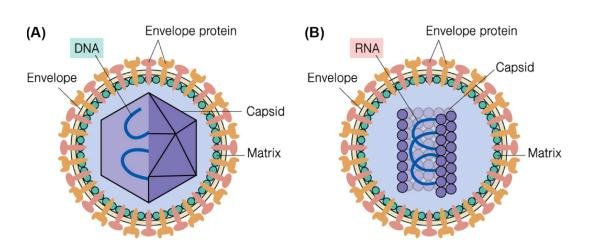
Basic Structure of a Virus:
1. Nucleic acid core; Contains either DNA or RNA as their genome but not both.
2. Capsid; A protein coat that encloses the nucleic acid genome.
Functions/Importance:
- Protects the nucleic acid from external environment.
- Mediates the attachment of virus to specific receptor on the target cell of the host
3. Envelope: Certain viruses are surrounded by a lipid containing membrane (envelope) outside the capsid. Envelope contains certain viral antigens.
Functions/Importance:
- Protection
- It also helps in attachment to the target cell.
Routes/ Portal of Entry of Important Viruses;
Respiratory tract : Influenza virus, Rhinovirus, Respiratory syncytial virus, Epstein-Barr virus. Varicella-zoster virus. Herpes simplex virus type 1, Cytomegalovirus, Measles virus. Mumps virus. Rubella virus. Hantavirus, Adenovirus
Gastrointestinal tract (Faeco- oral): Hepatitis-A virus, hepatitis-E virus, poliovirus, rotavirus
Skin : Rabies virus. Yellow fever virus. Dengue virus. Human papillomavirus
Blood; Hepatitis B virus. Hepatitis C virus. Hepatitis D virus. Human T-cell lymphotropic virus, Human immunodeficiency virus, Cytomegalovirus.
Transplacental; Cytomegalovirus, Rubella.
Retro Virus:
Retro viruses are a group of single stranded RNA viruses, which requires reverse transe intion from RNA to DNA for their replication.
Distinguishing Features:
- Possession of an enzyme called ‘Reverse transcriptase’ (RT).
- Simple in its organization as it is a bag of proteins containing within its core two molecules of RNA with RT.
- The size of a retro virus is around 100 nm
Steps in Viral Pathogenesis;
1. Attachment and entry within cells; Virus usually replicate at the site of entry, e.g. Respiratory tract, gastrointestinal tract, conjunctiva or directly introduced in blood, e g Hepatitis B virus, HIV.
2. Viral spread.
3. Tissue and cell tropism; Viruses tends to exhibit organ and cell specificities. It usually reflects the presence of specific receptors for that virus.
a) Systemic diseases- via blood e.g. rubella, measles -etc.
b) Diseases of specific organs-
- Liver diseases by Hepatitis viruses, Entero viruses.
- Respiratory tract diseases by Influenza virus. Parainfluenza virus etc.
- GIT diseases by rotavirus, Norwalk virus
4. Cell injury;
a) Cell necrosis.
b) Proliferation of the cell followed by necrosis.
c) Asymptomatic may also occur.
Common Viral Disease in Bangladesh:
1. Viral hepatitis,
2. Influenza,
3. Dengue
4. Bird flu
5. Chikungunya
6. Chicken pox
Classification of Viruses:
According to the suggestion of ICNV (International Committee on Nomenclature of Viruses) classification counts the following basis –
1. Type of nucleic acid.
2. Strandedness (Whether nucleic acid is single stranded or double stranded).
3. Presence of envelope.
4. Character of nucleic acid: Positive or negative strand.
5. Symmetry of genome.
6. Ether sensitivity.
On the basis of type of nucleic acid:
DNA viruses
Example:
- Poxvirus.
- Herpes virus.
- Hepadna virus
- Adenovirus.
- Papova virus.
- Parvo virus.
[For easy remember- PHHAPP]
RNA viruses
Example:
- Myxo virus.
- Rhabdo virus.
- Corona virus.
- Picorna virus.
- Toga virus.
- Arena virus.
- Reo virus,
- Retro virus.
[For easy remember-MRCP,TARR]
On the basis of strandedness:
Double stranded viruses
Example:
- Hepatitis B virus
- Herpes simplex virus
- Small-pox virus
- Small-pox virus
- Adenovirus
[All DNA viruses except parvo virus]
Single stranded viruses
Example:
- Hepatitis A virus
- Polio virus
- Dengue virus
- Measles virus
- Influenza virus
On the basis of presence of envelop:
Enveloped viruses
Example:
- Hepatitis B virus
- Herpes simplex virus
- Small-pox virus
Non-enveloped viruses
Example:
- Hepatitis A virus
- Rota virus
- Polio virus
On the basis of character of nucleic acid
Positive strand viruses
- Dengue virus
- Polio virus
- Hepatitis A virus
[For easy remember- DPH]
Negative strand viruses
Example:
- Influenza virus
- Measles virus
- Rabies virus
[For easy remember- IMR]

On the basis of symmetry of genome:
Icosahedral capsid:
Example:
- Hepatitis B virus
- Herpes simplex virus
- Adenovirus
Helical capsid:
Example:
- Influenza virus
- Measles virus
- Rabies virus
On the basis of ether sensitivity:
Ether sensitive:
Example:
- Herpes simplex virus
- Myxo virus
- Corona virus
Ether resistant
Example:
- Pox virus
- Adenovirus
- Parvovirus
Differences Between Virus And Viroids:
| Traits | Virus | Viroids |
| Genome | DNA or RNA | Only RNA |
| Protein coat or capsid | Present | Absent. |
| Envelope | May be present | Absent. |
| Pathogenicity | Can infect human | Only infect plants and animals |
Properties of viruses:
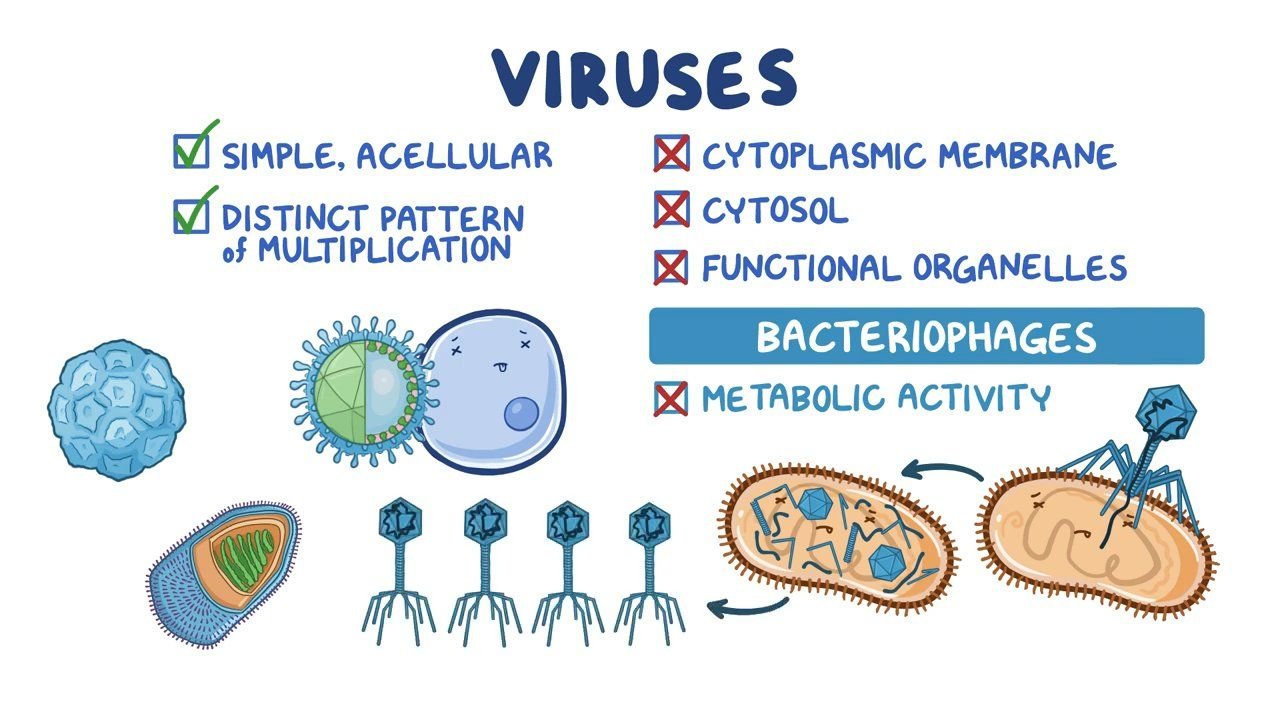
- Viruses are the smallest microscopic organisms. (Size: 20-300nm).
- Obligate intracellular parasite.
- Contain either DNA or RNA but not both.
- Parasite at genomic level
- They are acellular organisms.
- All viruses do not have enzymes for energy metabolism.
- They cannot synthesize protein due to absence of ribosome
- Viruses cannot grow in inanimate culture media
- Viruses have a distinctive life cycle inside a living cell. They do not undergo binaryawan fission or mitosis
- Viruses multiply by a process known as replication. One virus can replicate to produce hundreds of progeny viruses.
- Viruses are generally resistant to antibiotics,
- Viruses are sensitive to interferon.
- They contain organic chemicals like glycoproteins, lipid, nucleic acid, but no cell wall.
They have cell trophism. - Viruses are found in plants, animals and bacteria.
- Viruses are transmissible.
- Viruses can act as a genomic vector.
- They can integrate in human genome.
- Isolation & identification of viruses can be done by living tissue culture.
Comparison of Virus & Human Cell:
| Traits | Virus | Viroids |
| Cells | No | Yes |
| Nucleic acid | DNA or RNA, but not both | Both DNA & RNA |
| Type of nucleus | None | Eukaryotic |
| Ribosome | Absent | Present |
| Mitochondria | Absent | Present |
| Enzymes | None or few | Many |
| Multiplication | By replication | By mitosis |
| Lipoprotein membrane | Envelop present in some viruses | Cell membrane present in all human cells. |
| Protein | Few | Many |
Laboratory Diagnosis of Viral Diseases:
Principle: Diagnosis is based on the isolation and identification of the viral agents in cell culture and detection of specific antibody and viral antigens in the patient’s sera,
Specimen collection:
- Blood.
- Sputum.
- Nasal swab.
- Throat swab.
- Stool, urine, CSF.
- Biopsy.
- Autopsy materials
Microscopic methods:
- Direct examination of tissues and exudates ->> to see inclusion bodies or giant cells.
- Immunofluorescent staining.
- Electron microscopic studies of virus particles.
- Immune Electron Microscopy. (IEM)
Serological techniques:
➤ Humoral responses:
- Detection of specific antibodies: Immunodiffusion test, CIE, RIA, ELISA.
- Detection of viral antigens: RIA, ELISA, Nucleic acid hybridization, PCA.
➤ Cellular immunity:
- Dermal hypersensitivity test.
- Lymphocyte transformation test.
- Cytotoxicity test.
➤ Assay of viral neucleic acid and proteins:
- NA hybridization e.g. dot hybridization using radiolabelled DNA probes for diagnosis in smears-
✔ Adenovirus in nasopharyngeal swab.
✔ CMV in urine
✔ AIDS, HBV in serum.
- Other tests- ELISA, RIA.
➤ Detection of viral proteins: Electrophoresis, ELISA, Western blot, etc
Anti-Viral Drugs:
There is no effective drug to cure viral diseases completely. Following drugs are used to limit the progress the viral diseases:
| Mode of action | Antiviral agents | Indications |
|
Nucleoside analogues
|
Acyclovir | Herpes simplex |
| Ganciclovir | CMV | |
| Penciclovir | Herpes simplex; zoster | |
| Idoxuride | Herpes simple | |
| Tribavrin (Rivavrin)ed | RSV | |
| Trifluridine | Herpes simplex | |
| Vibaradine | Herpes viruses | |
| Zidovudine | HIV | |
| Lamivudin | Chronic hepatitis B | |
| Ribavirin | Respiratory syncytial virus; hepatitis C | |
|
Interference: uncoating of viral genome
|
Amantadine | Influenza A |
| Rimantadine. | Influenza A | |
| Immunomoniodulator | Isoprinosine | Herpes simplex |
| Inhibition of DNA polymerase | Foscarnet | CMV; aciclovir- resistant herpes simplex or varicella zoster |
|
Inhibit virus replication
|
Interferon-alpha
|
Rhinoviruss |
| HBV, HCV, HDV in chronic hepatitis. | ||
| Reverse transcriptase inhibitors | Nevirapine, delaverdine and efavirenz. | HIV |
|
Protease inhibitor
|
Indinavir |
HIV
|
| Ritonavir | ||
| Inhibition of release | Zonamivir | Influenza virus |
| Nucleotide analogue | Cidofovir | CMV & HPV |